The motive behind Russia’s initial move to militarise Syria was at best, unclear.
Although President Putin at one point spoke of it as a both a humanitarian and anti-terrorism move, little has been done in way of humanitarian work drawing scepticism from western analysts. Furthermore, while ISIS may be a threat to Russia, it posed no more or less of a threat than other terrorist groups.
So what was the real reason behind the Russian occupation of Syria? The answer, perhaps, was hiding in Russia’s nationalistic culture; a latent fantasy – inherited from the Soviet era – of portraying a powerful and globally assertive image-empire, was provoked, to awaken from decades of hibernation. Let me explain:
Amongst other things, Russia’s herculean military enables it to have a voice and influence in international affairs. However, national strength doesn’t lie in brute force alone; such force must be projected globally in order to define Russia as a power to be reckoned with. This is especially apparent in the Middle East, where there is nothing more vital to its deployment capabilities, than its naval fleet.
The problem is that although Russia’s landmass is large, during winter its ports are frozen over which drastically reduces mobility. Although icebreakers are able to separate
the ice and allow ships passage, ice breaking is a slow process and only limited number of capable ships can transit. To rely only on cold water ports would severely limit its global power projection and therefore it is crucial for Russia to maintain warm-water ports in the south.
Russia currently has two globally accessible warm water ports; Tartus in Syria and Sevastopol in Crimea.
Sevastopol
In the 1990’s the port was leased to the Russians on a long-term lease. In 2012 Ukraine wanted to join the EU. However they had new elections and Viktor
Yanukovych was elected as the President. Yanukovych was pro-Russian, and he rejected the EU association agreement and instead pursued closer ties with Russia. This resulted in mass demonstrations in Ukraine and continued until Ukraine appeared to be on the brink of civil war. In February 2014 Yanukovych fled to Russia. The conflicts in Ukraine threatened Russia’s warm water port Sevastopol. Also at that time it appeared that the rebels in Syria would defeat Assad, which could result in the loss of Russia’s port in Tartus. So in March 2014 Russia annexed Crimea, thus enabling them to maintain control of Sevastopol. To quote Forbes; “Put simply, without a naval base in Crimea, Russia is finished as a global military power.”
However although Russia now has control of Sevastopol, the port has a key limitation. Access from Sevastopol to the Mediterranean – aka the world – via the Turkish straits; the Bosphorus and Dardenelles, relies completely on Turkish goodwill. Russia and Turkey
have never been on good terms, thus it was necessary for Russia to also secure their port at Tartus; Syria in the event of a Turkish blockade. Incidentally, such a blockade would also be catastrophic for the Russian campaign in Syria, as Tartus is inaccessible by land.
Tartus
During the cold war, the Soviet made deals with several nations in the Middle East which enabled them to lease ports, this included a deal with Syria to lease Tartus. However at the fall of the Soviet Union, most of these alliances and deals likewise collapsed, excluding the Tartus agreement which remained leased to the Russians. This was possible in 2005 when Russia forgave 73% of Syria’s 13.5 billion dollar debt to Russia. In exchange for this reduction in debt, it appears Syria gave permission to Russia to develop and enlarges their port at Tartus.
How amazing it is to see the Elohim allow that that single, yet strategically chosen port to stay within Russian hands for a future purpose. There are not many other options of ports in the Mediterranean for the Russians to use. Although Russia is allies with countries like Libya, they are too unstable. Other options such as Egypt would be viewed as politically dangerous as it would cause conflict with the UK or US. Syria is geographically very close to Russia, and with no other option, it made sense for Russia to develop Tartus.
Russian naval squadron en route to Syria
It wasn’t until Russia secured Sevastopol, that it set eyes on Tartus. Around the same time that Russia invaded Crimea, the Syrian civil war began threaten Russia’s lease of Tartus. On the 30th of September 2015, Russia responded to the threat by fortifying Tartus and setting up infrastructure to neutralise the Rebel factions which were closest to the base.
By intervening in Syria, Russia first secured Tartus enabling it to become the base of its power projection in the Mediterranean and consequently the world. Secondly and perhaps inadvertently, it gave Russia an opportunity to begin the awakening of its image-empire. Already, both the Papacy, and Europe are looking to Russia for help.
Even though Russia is suffering from US-imposed sanctions due to the annexation of Crimea, it appears that by involving itself in the Syrian civil war – under the guise of humanitarian and anti-terrorism endeavours – that it has been given an opportunity to stop the migrant flow into Europe and become the indispensable European partner. As both the migrant crisis and terrorism grows, Russia will gain increasing leverage over the West and position themselves to have sanctions removed. Germany is already in favour of the removal of sanctions against Russia.
Scriptural significance
Daniel 11:40 talks of a latter day manifestation of the King of the North. Prior to verse 40, the ancient King of the North occupied and controlled the area of the Seleucid empire which included todays Iraq and Syria. To be a letter day manifestation of the same empire, the latter day King of the North must occupy the same region. We are beginning to see the fulfilment of this! Russia is not only in Syria now, but also beginning to enter Iraq to conquer ISIS.
As Russia has become unwittingly involved in the Syrian Civil war while endeavouring to fortify Tartus, it has stumbled across an unfortunate foe – ISIS. ISIS have dragged Russia into conflict, and not only Russia, but most of the world’s largest superpowers. Ezekiel prophesied that one day, Russia would be dragged down to build a confederacy, and to do this, God would put “hooks in their jaws” (Ezekiel 38). It’s possible this is being fulfilled through ISIS. The nations are now gathering just North of Israel and coalitions are being forged.
Through Russia’s endeavour to become a world power by expanding their naval access, the angels are pushing Russia to become the KON, which means this is the last days! We are on the brink of Christ’s return.
Note: This post was generously written and contributed by a young Sister who prefers to remain anonymous.
As Russia aims its heavy weapons at Turkey causing the world to watch on in suspense, a scene is playing-out between the two belligerents, one in which the world has little control.
However, what many don’t realise, is that in another part of the world, seeds are being sown for the emergence of an even greater crisis.
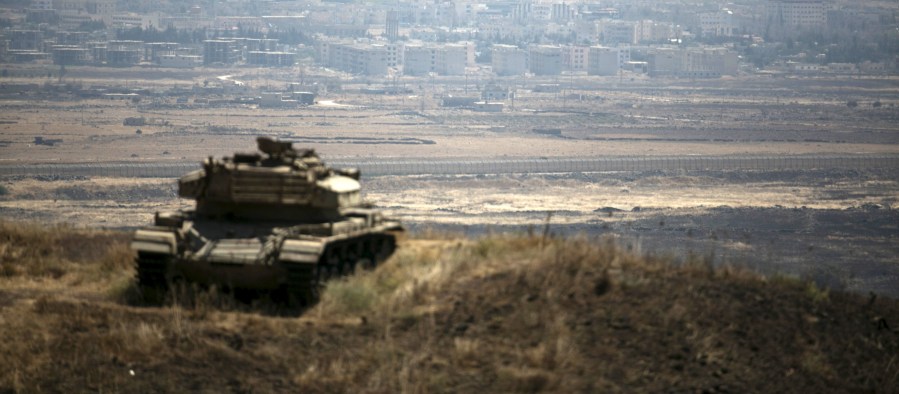
It was during the remarkable events of the Six Day war in 1967, that Israel captured the Golan Heights.
After capturing the Golan, the idea was for the Israeli government to use it as bargaining chip for any post-war negotiation, or keep it as a buffer zone to reinforce territorial security against any future Syrian aggression.
Israeli tanks roll into the Golan in 1967
Since then, continued Israeli occupation of the Golan is an arrangement which, in light of recent information, could be a latent catalyst for a Russian invasion.
Its possible that in the very act of seeking security through continued occupation, Israel may have unwittingly guaranteed a future confrontation with Russia.
Unprecedented oil deposits discovered on the Golan
In October, an Israeli energy company – Afek – was drilling around the Golan and discovered unprecedented amounts of oil.
Afek’s Chief Geologist – Dr. Yuval Bartov, said to Israel’s Channel 2 News;
“We are talking about a strata which is 350 meters thick… On average in the world strata are 20-30 meters thick. This is ten times as large as that, so we are talking about significant quantities.”
Just as Israel’s offshore Mediterranean gas discoveries created an entire energy industry, so the Golan oil find could transform Israel into a supplier.
However, while the gas is generally recognised to be within Israeli territory, the oil discovery on the Golan is not.
The disputed sovereignty over the Golan
Since 1967, the international community of nations have only recognised Syrian ownership of the Golan.
Upon publishing news of the Golan discovery, Russian state-owned media was quick to claim that “The region is internationally recognized Syrian territory”.
Until recently, the dispute over Golan sovereignty was largely just a war of words: where the United Nations would pass majority supported resolutions condemning Israel for its occupation, Israel would respond by ignoring any demands to relinquish the territory.
But everything changed in September 2015, when Russia moved into Syria.
Russia suddenly acquired a direct and vested interest in Syrian national and geographic integrity, including, the Golan Heights. From that moment on, an intriguing series of events unfolded.
Israel fails to secure US support
Almost a month after the oil discovery, Netanyahu had a meeting planned with Obama at the White-house.
As part of the meeting, Netanyahu tried to include the question of Golan occupation on the agenda, but it was rejected on the basis that the U.S. position, which objects to Israel annexing the Golan Heights, remains unchanged.
Russia condemns Israel and says the Golan belongs to Syria
A week after Netanyahu’s visit, the question of Golan occupation once again came to the fore when the United Nations voted on a resolution submitted by Syria for Israel to be removed from Golan occupation.
The motion was passed with a strong majority, but most notably, the Russian Federation supported the resolution condemning Israel for its occupation.
The resolution claimed that Israel’s hold over the Golan Heights, was “a stumbling block in the way of achieving a just, comprehensive, and lasting peace in the region.”
Syria has just asked Russia to develop its oil resources
A week after re-affirming the view of the international community regarding Israels occupation, the Syrian president – Bashar al-Assad – took the opportunity to ask Russia to help develop Syrian oil resources.
At this point, the focus on development is on sea based resources, however this could change if it becomes apparent that the Golan offers low cost extraction for high return.
UPDATE: Israel is “very concerned” about Russian activity near the Golan
It has since come to light that the Israeli government is significantly concerned about Russian military activity near the Golan as the motives of the military are unclear.
While the oil discovery rekindles the international debate on Golan sovereignty, Russia continues to support the convenient view that an Israeli occupation of the Golan is a threat to peace in the Middle East.
How far will Russia go to take a spoil under the guise of achieving “peace” in the Middle East?
And thou shalt think an evil thought…
Art thou come to take a spoil?
hast thou gathered thy company to take a prey?
to carry away silver and gold, to take away cattle and goods,
At this point, the Russian Foreign minister has indicated that Russia “does not want to go to war with Turkey”.
HOWEVER, the crisis is far from over – Russia is beginning to hurt Turkey in other ways:
Russia’s Foreign Ministry has urged the country’s citizens to defer all travel to Turkey and advised all Russians currently in Turkey to depart as soon as possible.
Russia immediately deployed advanced air defence in Syria, placing herself in a far better defensive position from which to launch an invasion in future.
Instinctively, Russia begun bombarding Turkmen insurgents, who have ethnic ties to Turkey — ignoring demands made by Turkey over the past week to end its military operations close to the Turkish border.
Russia is planning and executing a range of economic sanctions against Turkey.
Russia is denying entry to Turkish citizens.
The Kremlin has arrested a number of Turkish businessmen in Russia.
Russian no longer considers Turkey to be an ally.
Its hard for anyone to see how this situation might de-escalate in the long term especially as this incident seems to be a symptom of a broader historical problem between the Russians and Turks.
Given the trail of prophetic fulfillment over the last few months who knows what might happen next. We await in anticipation!
As we await a response from Putin, its worth quoting from a previous post regarding the current Russian-Turkish crisis:
On the 3rd of August, it was reported that Putin had threatened Turkeys president and this is what he allegedly said:
“Tell your dictator President he can go to hell along with his ISIS terrorists, I will make Syria a ‘Big Stalingrad for him!”
The source (Moscow Times) was questionable and so when we first published this, the prospect of Russian intervening in Syria was met with skepticism.
However, within a month of this article being published, Putin surprised the world and moved his military into Syria.
On September the 24th, the same source reported that Putin had given another message to the Turkish President, this time, a more direct one:
“If necessary we can stage a swift military coup against you, unless you desist from your desperate acts of supporting the violent Al-Qaeda terrorists.”
And then yesterday happened.
No one knows yet how Putin will choose to respond, but we don’t need to look further past the Chechen war, or the recent bombing of Raqqa (due to the Sinai bombing of the Russian airliner) to know that Putin has a history of heavy-handed responses.
It wouldn’t be too hard for Russia to invade Turkey – Even the US military is worried about Russia’s military capability.

 landmass is large, during winter its ports are frozen over which drastically reduces mobility. Although icebreakers are able to separate
 leased to the Russians on a long-term lease. In 2012 Ukraine wanted to join the EU. However they had new elections and Viktor
 Dardenelles, relies completely on Turkish goodwill. Russia and Turkey


 Bible Prophecy & Current Events