Part 2: The First Hill Country Settlers

Continued from Part 1…

But most of all, to the men who moved there first, the Hill Country was beautiful because of the grass. Land was something these men and their families had to live off, and that was why the grass of the Hill Country filled their dreams.

The numbers of the settlers who reached as far as the Hill Country were very few. In 1837, after becoming independent from Mexico, the Republic of Texas had a total population of 40,000. But when Texas was opened up to settlement from the United States, the population grew rapidly to about 600,000 by the time of the Civil War, in 1860.
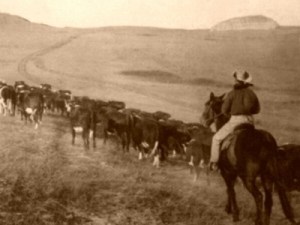
After the Death large_2038_CattleTrail1905-4-3-600
A cattle drive through the Texas Hill Country

Nearly all of these new settlers,  however, stopped in the rich blackland farm country of East Texas, near Louisiana and Arkansas. Only a very thin trickle of immigrants made their way out to the edge of the Hill Country, to places like Austin. At this time, this was the true American frontier. And of those few who came so far, to the very edge of civilization, only a very, very few — just thousands at most — found the courage to climb the hills and enter what seemed to be a new paradise to the west.

But the Hill Country, beautiful as it might appear, was really a trap, and the trap was baited with that beautiful grass. The grass had been a long time growing; the soil in which it grew was rich, but it was also very thin, a fragile layer spread over the limestone rocks. It was vulnerablePlow to wind and rain, and especially vulnerable because it lay on hillsides, not level ground. The very hills that made the Hill Country so picturesque also made it a country it which it was difficult for the soil to hold. The grass of the Hill Country was beautiful and rich because it had had centuries to grow and build up, centuries in which nothing had disturbed it. It was rich only because it was virgin soil, never touched by a plow. But once the plows came, it could not be restored to its previous condition.
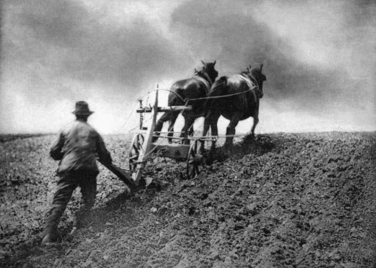
The Hill Country, beautiful though it might be, was also a trap baited with water. It is now known and recognized that the climate of the Texas Hill Country is, in official meteorological jargon, semi-arid. The annual rainfall in the whole region fluctuates dramatically. One year the rainfall might be 40 or 50 inches, and the next only 10 inches.

In the 1850s and ’60s more settlers arrived for the first time in the Hill Country, after it had had years of above-average rains, and the land had the appearance of a Garden of Eden, at least, a Texas-style Garden of Eden. But then the rains stopped, for one year and then another. The new settlers knew it should rain again, for they had seen it. But the creeks dried up, and the grass withered, and the crops of cotton and corn shriveled in the fields, and still there was no rain.

More than a hundred years later, the climate of the Hill Country still repeated such cycles. One of my earliest memories was at the age of three or four, living in San Saba in the heart of the Hill Country — the years (the early 1950s) of the great seven-year drought — one Texas author who lived through it called it “The Time It Never Rained”. I remember my parents sitting at the dinner table, night after night, asking themselves, “When will it rain again?” And I remember my mother warning me, “George, be careful playing on the back lot!” The gaping cracks in the dry, barren ground were so deep and wide that a little boy chasing a ball could literally fall in one, and twist an ankle, or worse.

Comanches
A Group Comanche Warriors

The promise of a new and fruitful region, with land for the taking, lured some of the most desperate, and idealistic, settlers from the United States. On and on they pressed, to the edge of civilization and beyond, into the heart of the Hill Country, the home of the Comanches and Apaches — nomadic Indians fearful for their own way of life, utterly ruthless warriors, and masters of various torture techniques. The border of civilization ebbed and flowed during these years, and at times many settlers were caught on the wrong side of the Indian frontier. The years 1858 and 1859 came to be known as the “killing years”; several hundred settlers (no one knows for sure just how many) died in Indian massacres, often suffering horribly before finally being killed.
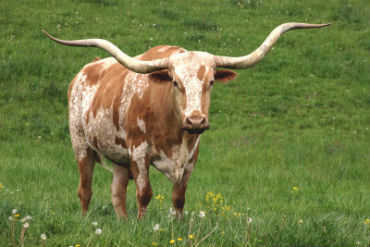
cattlefolk-longhorn
The legendary longhorn

A couple of generations later, those who survived the Hill Country knew how to make a living there: by running wide-ranging herds of cattle (the tough and hardy Longhorns, at first) on vast tracts of land, by herding sheep and goats on the steep hills, and by growing peaches and grapes (but not cotton or grain) in the fields. But fortunes were lost, and lives destroyed, while the next generations learned the lessons from those who came first!

Note: Parts of this section as well as the previous section rely on the first volume of the richly detailed history, The Years of Lyndon Johnson: Path to Power, by Robert A. Caro. Mr. Caro, in turn, relied on personal narratives from many members of the Johnson family, including my grandmother Jessie Hatcher, for details of the family history and Hill Country life in the early days of Texas settlement.

To be continued.


This post is part of a series authored by brother George Booker. Click here to see all previous posts in the series.

Part 1 – The Texas Hill Country

Who doesn’t remember the old Western movies? They were filled with cattle drives, wagon trains, cowboys and Indians, horse thieves and cattle rustlers, vigilante justice, brave sheriffs with six-guns strapped at their sides — and strong, hard-working, kind women in long dresses and bonnets.

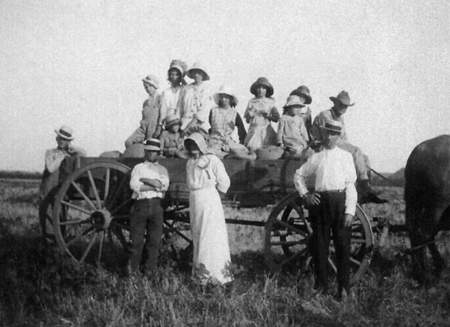
frontierfolk-familybuckboard
A family gathers for a photo near Gatesville, Texas. — late 1800s

If you remember those movies, then you can remember the landscape too, right?

Pastures with grazing cattle, rugged hills, dry creek beds, mesquite, sagebrush, a land of big skies, a land of splendid isolation. A place where most people lived miles and miles from the nearest town, where men and women learned independence and self-reliance, where life was tough — they called it a “hardscrabble” life. But it was also a place where life was also what people had the desire, and faith, and courage, to make it, with few social conventions and traditions to get in their way.

If, in your mind’s eye, you begin to see such a place and time, then you are seeing the Texas Hill Country, just west of Austin and San Antonio, in the 1860s, and ’70s and ’80s.

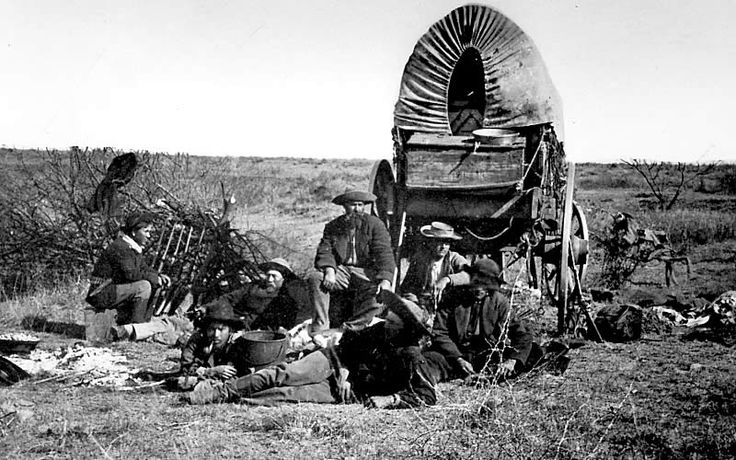
Buffalo hunters at their camp in Texas, about 1877
Buffalo hunters at their camp in Texas: 1877

It is the place and the time where the story of Texas Christadelphians begins.

Texas was a land of dreams; a land of wide horizons and wider opportunities. To men and women who passed through the deep forests of Alabama or Tennessee, and then trudged across hundreds of miles of green but monotonous Texas plains, the first sight of the Hill Country of Texas was invigorating, inviting, and even just a little beautiful, in a rugged, Texas sort of way.

The first sight of those hills still recalls the same feelings, even now, and even when encountered on a highway, in a comfortable car. You get this very view as you leave our home in Austin, and reach the

Journey to the West by Wagon Trains

western outskirts of the city, only a few miles away. There the hills start to rise, not steeply but gradually, with long vistas broken up by little valleys. It starts to feel totally isolated, even from the 21st century. The valleys are dotted with little family cemeteries, the stones telling their stories of hardship and suffering, of babies lost to unknown diseases.

As you drive on, following the trails that the settlers of 150 years ago followed, you realize that each line of hills is followed by another, and another, and there seems no end to the hills. They climb slowly but steadily higher, and there is always another ridge.

The Texas Hill Country, also known as the Edwards Plateau, stretches out southwest and northwest from the big cities of Austin and San Antonio, until it reaches at last to the Rio Grande and Mexico, or the high plains bordering on the deserts of New Mexico, where towns have names like Plainview or Levelland. The Hill Country covers a vastness of southwest Texas greater in size than several northern or eastern states; it is about the same size as all of England.

To the first settlers, the air of the hills was drier and clearer than the air on the plains below; it felt clean and cool on the skin. The sky, in that clear air, free of practically all the pollution we take for granted these days, was a blue so brilliant that one of the early settlers called it a sapphire sky.

Hill Country Pasture_post (1)
“HILL COUNTRY PASTURE” – plein air and studio landscape painting by Texas modern impressionist Jimmy Longacre

Beneath the trees, the Hill Country was carpeted with wildflowers in the spring, bluebonnets, buttercups and Indian paintbrush (gold and scarlet). In the fall, rather unexpectedly, the maples in the valleys turned fiery red.

Springs gushed out of the hillsides, and streams ran through the hills. Sometimes they formed dark, cold pools. After crossing hundreds of miles, the settlers from a relatively crowded and closed-in east found a landscape entirely new, and open and fresh.

The streams were full of fish, and the fields were full of deer and rabbits and huge flocks of wild turkeys. One of the first white men to come to the Hill Country wrote simply, “It is a paradise!”

To be continued.


This post is part of a series authored by brother George Booker. Click here to see all previous posts in the series.
New Series: Memories of the Hill Country

A few weeks ago, I wrote about US President Johnson’s relationship with the Christadelphians and how that impacted Israel’s Six Day war.

The post received much attention, but I was especially intrigued after writing the post to receive an email from a relative of the subject; brother George Booker, the grandson of Sister Jessie Hatcher who is the “Aunt Jessie” of the story. Readers might already be familiar with two of brother George’s books which were published via the Tidings; “On the Way” (2014) and “A Bible Journal” (2015).

Since making contact, brother George has accepted an invite to publish a series on this blog which will cover the beginnings of the first Christadelphian American settlers in Texas and their growth right through to the time of President Johnson and beyond.

Its a story that begins with the preaching of the truth in the mid 1800’s amongst a settler community on the very frontier of civilisation. The wild landscape of Texas – as beautiful as it was – didn’t come without trial and hardship for those seeking to build a home and make a living. The challenges of the American civil war and the scuffles between the Cowboys and Indians came to bear on the community, but never stopped the work of the truth. Back then, our brothers and sisters had much to contend with. Their means were small, but their efforts to preach, were tremendous.

So please, join us, as we follow the journey of the Texas Christadelphians through to recent times, and also reflect on the family who later surrounded and impressed US President Johnson with a love of Israel.

I’m sure Bro. George would appreciate any comments or questions, so if anything comes to mind, don’t hesitate to post it in the comments section.

All posts in the series will be located via this link:

Memories of the Hill Country

The first post in the series will be published soon.

In Christ,

Bro. Michael

The real motive behind Russia’s move into Syria

The motive behind Russia’s initial move to militarise Syria was at best, unclear.

Although President Putin at one point spoke of it as a both a humanitarian and anti-terrorism move, little has been done in way of humanitarian work drawing scepticism from western analysts. Furthermore, while ISIS may be a threat to Russia, it posed no more or less of a threat than other terrorist groups.

So what was the real reason behind the Russian occupation of Syria? The answer, perhaps, was hiding in Russia’s nationalistic culture; a latent fantasy – inherited from the Soviet era – of portraying a powerful and globally assertive image-empire, was provoked, to awaken from decades of hibernation. Let me explain:

Amongst other things, Russia’s herculean military enables it to have a voice and influence in international affairs. However, national strength doesn’t lie in brute force alone; such force must be projected globally in order to define Russia as a power to be reckoned with. This is especially apparent in the Middle East, where there is nothing more vital to its deployment capabilities, than its naval fleet.

The problem is that although Russia’s 1234landmass is large, during winter its ports are frozen over which drastically reduces mobility. Although icebreakers are able to separate
the ice and allow ships passage, ice breaking is a slow process and only limited number of capable ships can transit. To rely only on cold water ports would severely limit its global power projection and therefore it is crucial for Russia to maintain warm-water ports in the south.

Russia currently has two globally accessible warm water ports; Tartus in Syria and Sevastopol in Crimea.

Sevastopol

In the 1990’s the port was12345 leased to the Russians on a long-term lease. In 2012 Ukraine wanted to join the EU. However they had new elections and Viktor
Yanukovych was elected as the President. Yanukovych was pro-Russian, and he rejected the EU association agreement and instead pursued closer ties with Russia. This resulted in mass demonstrations in Ukraine and continued until Ukraine appeared to be on the brink of civil war. In February 2014 Yanukovych fled to Russia. The conflicts in Ukraine threatened Russia’s warm water port Sevastopol. Also at that time it appeared that the rebels in Syria would defeat Assad, which could result in the loss of Russia’s port in Tartus. So in March 2014 Russia annexed Crimea, thus enabling them to maintain control of Sevastopol. To quote Forbes; “Put simply, without a naval base in Crimea, Russia is finished as a global military power.”

However although Russia now has control of Sevastopol, the port has a key limitation. Access from Sevastopol to the Mediterranean – aka the world – via the Turkish straits; the Bosphorus and 123455Dardenelles, relies completely on Turkish goodwill. Russia and Turkey
have never been on good terms, thus it was necessary for Russia to also secure their port at Tartus; Syria in the event of a Turkish blockade. Incidentally, such a blockade would also be catastrophic for the Russian campaign in Syria, as Tartus is inaccessible by land.

Tartus

During the cold war, the Soviet made deals with several nations in the Middle East which enabled them to lease ports, this included a deal with Syria to lease Tartus. However at the fall of the Soviet Union, most of these alliances and deals likewise collapsed, excluding the Tartus agreement which remained leased to the Russians. This was possible in 2005 when Russia forgave 73% of Syria’s 13.5 billion dollar debt to Russia. In exchange for this reduction in debt, it appears Syria gave permission to Russia to develop and enlarges their port at Tartus.

How amazing it is to see the Elohim allow that that single, yet strategically chosen port to stay within Russian hands for a future purpose. There are not many other options of ports in the Mediterranean for the Russians to use. Although Russia is allies with countries like Libya, they are too unstable. Other options such as Egypt would be viewed as politically dangerous as it would cause conflict with the UK or US. Syria is geographically very close to Russia, and with no other option, it made sense for Russia to develop Tartus.

a55ebf70a48e88d6d2a23ae32e927b67
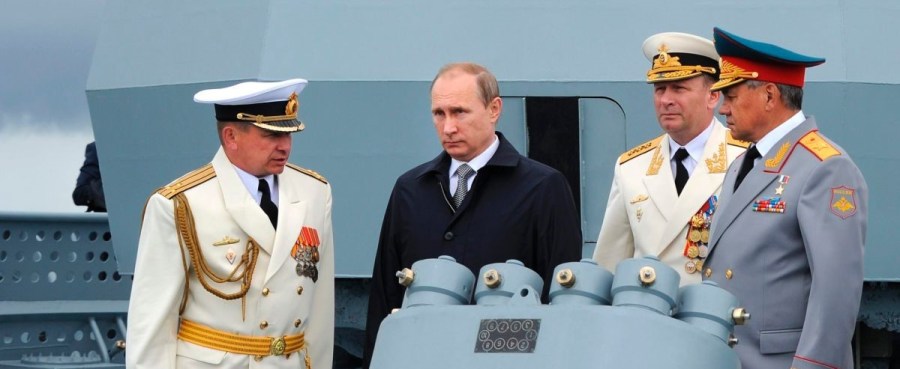
Russian naval squadron en route to Syria

It wasn’t until Russia secured Sevastopol, that it set eyes on Tartus. Around the same time that Russia invaded Crimea, the Syrian civil war began threaten Russia’s lease of Tartus. On the 30th of September 2015, Russia responded to the threat by fortifying Tartus and setting up infrastructure to neutralise the Rebel factions which were closest to the base.

By intervening in Syria, Russia first secured Tartus enabling it to become the base of its power projection in the Mediterranean and consequently the world. Secondly and perhaps inadvertently, it gave Russia an opportunity to begin the awakening of its image-empire. Already, both the Papacy, and Europe are looking to Russia for help.

Even though Russia is suffering from US-imposed sanctions due to the annexation of Crimea, it appears that by involving itself in the Syrian civil war – under the guise of humanitarian and anti-terrorism endeavours – that it has been given an opportunity to stop the migrant flow into Europe and become the indispensable European partner. As both the migrant crisis and terrorism grows, Russia will gain increasing leverage over the West and position themselves to have sanctions removed. Germany is already in favour of the removal of sanctions against Russia.

Scriptural significance

Daniel 11:40 talks of a latter day manifestation of the King of the North. Prior to verse 40, the ancient King of the North occupied and controlled the area of the Seleucid empire which included todays Iraq and Syria. To be a letter day manifestation of the same empire, the latter day King of the North must occupy the same region. We are beginning to see the fulfilment of this! Russia is not only in Syria now, but also beginning to enter Iraq to conquer ISIS.

As Russia has become unwittingly involved in the Syrian Civil war while endeavouring to fortify Tartus, it has stumbled across an unfortunate foe – ISIS. ISIS have dragged Russia into conflict, and not only Russia, but most of the world’s largest superpowers. Ezekiel prophesied that one day, Russia would be dragged down to build a confederacy, and to do this, God would put “hooks in their jaws” (Ezekiel 38). It’s possible this is being fulfilled through ISIS. The nations are now gathering just North of Israel and coalitions are being forged.

Through Russia’s endeavour to become a world power by expanding their naval access, the angels are pushing Russia to become the KON, which means this is the last days! We are on the brink of Christ’s return.

Note: This post was generously written and contributed by a young Sister who prefers to remain anonymous.