This week – Putin, Syria, Europe & the Pope

Putin officially confirms that he has forces in Syria.

Another milestone in current events – Putin himself has officially confirmed reports that he has boots on the ground in Syria.

Russia has sent the biggest nuclear submarine in the world down to Syria

The world’s largest submarine, the Dmitri Donskoy (TK-208), Nato-coded Typhoon, has set sail for the Mediterranean and is destined for the Syrian coast, DEBKAfile reports exclusively from its military and intelligence sources. Aboard the sub are 20 Bulava (NATO-code SS-N-30) intercontinental ballistic missiles with an estimated up to 200 nuclear warheads. Each missile, with a reported range of 10,000km, carries 6-10 MIRV nuclear warheads.

The Russian sub set sail from its North Sea base on Sept. 4, escorted by two anti-sub warfare ships. Their arrival at destination in 10 days time will top up the new Russian military deployment in Syria.

Europe is experiencing more instability with a migrant & a farmers crisis

Thousands of migrants have crossed into Austria and Germany, following a long journey that has brought many from conflict zones like Syria into the heart of Europe.

Police have used water cannon during a farmers’ protest in Brussels. Hundreds of protesters were throwing stones, eggs and firecrackers at officers and used two tractors to try and break through a cordon.

Not what you expect to to see in Brussels which is the de facto capital of the European Union (EU) and headquarters for NATO.

Russia had a hand in this when it decided to cut off agricultural imports from Europe.

The EU can only suffer from so much instability. Greece is dragging them down. What will Russia do next?

The False Prophet speaks again

Pope Francis has called on every European parish to host one refugee family each in a goodwill gesture that will begin in the Vatican state. It comes as Europe faces the worst refugee crisis since World War II.

Click here to see a timeline of notable current events coming up this month.

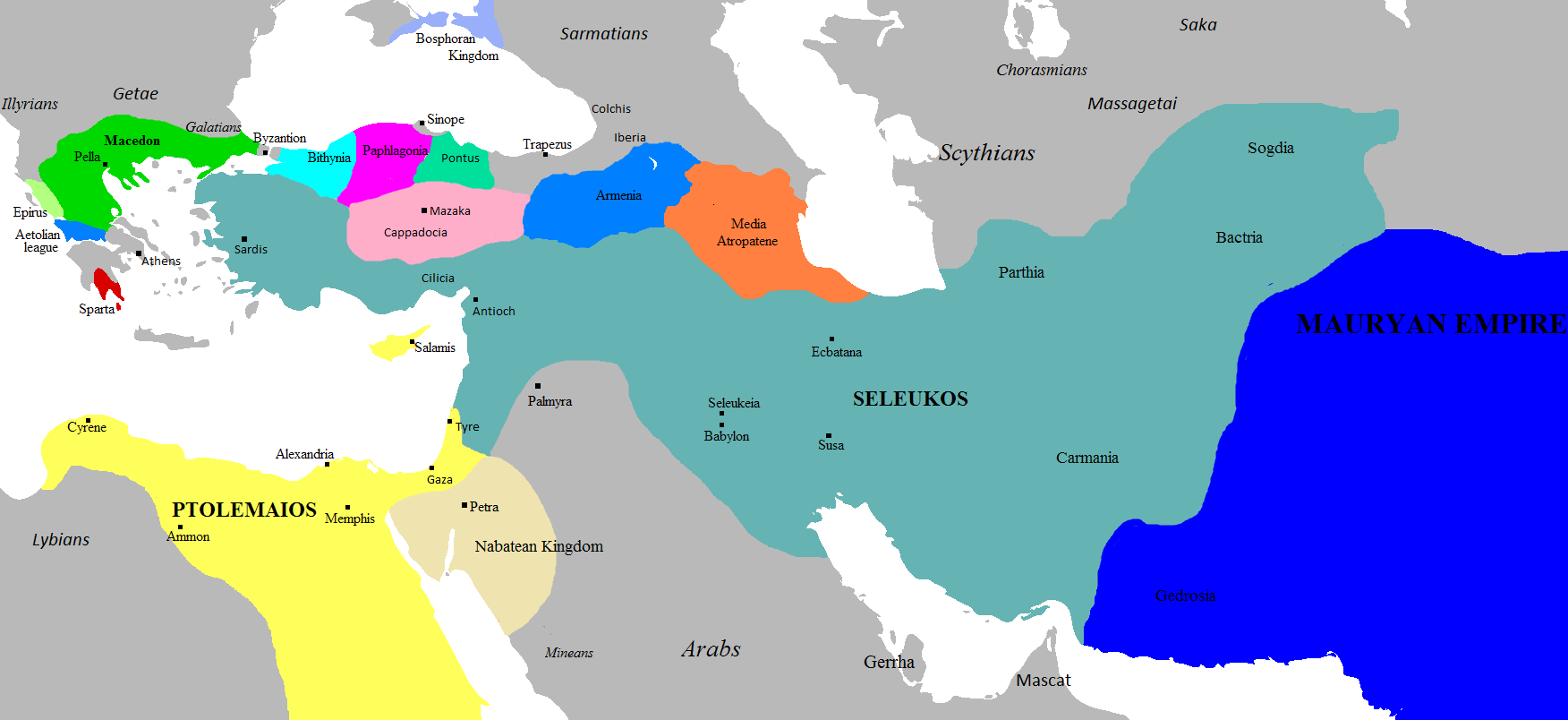
Putin begins to take the Seleucid Empire.

For the first time ever, Putin has officially confirmed reports that he has operational boots on the ground in Syria. Wow.

This momentous admission means nothing on its own, but everything for those who understand Daniel 11.

Syria is not what matters here. What matters is that Putin has an occupational ground force inside the ancient Seleucid Empire, and he just admitted it.

This news comes only a few days after we heard that Egypt has discovered what is likely to be the biggest gas field in the world!

This week is a milestone indeed and shows us without a doubt that Daniel 11 is fast becoming a reality.

Why is this so significant?

In Daniel 11, the angel (probably Gabriel) tells Daniel a prophecy that will occur around “the time of the end”.

Interwoven throughout the prophecy is the “King of the North” who was and is the occupational power of the area of the ancient Seleucid Empire which today includes Syria.

The King of the South is the occupational power of the Ptolemic Empire which includes the territory of Egypt.

Seleucid Empire

Up till now, Russia had only asserted herself as the regional power via proxy.  It would supply the Arab states with weapons and act as a diplomatic power broker on behalf of regional states. It also had some military bases in the region but was never actively participating in warfare.

However it wasn’t until yesterday that Putin confirmed that his troops are in Syria and are actively engaged in war against Syrias enemies, making it the first time that Russia has had an operational ground presence within the Seleucid empire bringing him a step closer to becoming the King of the North.

This is a milestone indeed.

Furthermore, we heard this week that Egypt have discovered the biggest gas field in the world.

Why is this important? because Daniel 11 says of the King of the North in the latter day:

He (The King of the North aka Russia) shall stretch forth his hand also upon the countries: and the land of Egypt shall not escape. But he shall have power over the treasures of gold and of silver, and over all the precious things of Egypt:

Even so, Come Lord Jesus.

Russia is deploying its Airforce & Groundforce to Damascus

YNet Reports:

Russia begun its military intervention in Syria, deploying an aerial contingent to a permanent Syrian base in order to launch attacks against ISIS and Islamist rebels; US stays silent.

DebkaFile reports:

Russia will be the first country from outside the Middle East to send ground forces into the Syrian civil war.

Daniel 11 is becoming more of a reality every day.

Egypt discovers a ‘Supergiant’ gas field.

As one brother aptly described it; “This is huge. It’s almost too perfect. It’s what we have been waiting for.”

What is it? If you havent already heard, Egypt has discovered what is likely to be the biggest gas field in the world.

Why is this significant? Because in Daniel 11, the King of the North invades Egypt to take her precious gold and silver.

Up till recently, Egypt didnt seem to have anything that would be of significant value to Russia, but now they do.

For almost two centuries the brotherhood have wondered what it is that Russia might want from Egypt.

We are a generation who are very blessed to be able to witness the awakening of Daniel 11 – the Invasion of the King of the North.

He (the King of the North: Russia) shall stretch forth his hand also upon the countries: and the land of Egypt shall not escape.

But he shall have power over the treasures of gold and of silver, and over all the precious things of Egypt

~Daniel 11

RT Reports:

Italian energy giant Eni has announced on its website that it has found a “supergiant” gas field at their Zohr Prospect in the deep waters of Egypt in the Mediterranean, claiming it “could become one of the world’s largest natural-gas finds.”

It added that this is “an important day” for the company, as well as for Italy and Egypt, as it could fuel Italy’s economic development and “will be able to ensure satisfying Egypt’s natural gas demand for decades.”

“It’s a very important day for Eni and its people. This historic discovery will be able to transform the energy scenario of Egypt,” Claudio Descalzi, chief executive of Eni, said in a statement.

The field is located about 80 miles (129 kilometers) off the Egyptian coast, 1,450 meters below the surface.

According to Eni’s press-release, the discovered gas field, which covers an area of around 100 square kilometers, could contain about “30 trillion cubic feet of lean gas”(849 billion cubic meters of gas or 5.5 billion barrels of oil equivalent).

Even more oil could be found at the field during the course of further exploration, potentially amounting up to 40 trillion cubic feet (1.1 trillion cubic meters), Claudio Descalzi told Financial Times.

“I think we can discover more,” he said.

In June, Eni struck a $ 2 billion deal with the Egyptian oil ministry allowing it to carry out exploration in Sinai, the Gulf of Suez, the Mediterranean and areas in the Nile Delta.

Claudio Descalzi stressed that “Egypt still has great potential” in the energy field.”

“Important synergies with the existing [Egyptian] infrastructures can be exploited, allowing us a fast production startup,” he added.

Turkey is now entering a period of instability – Enter Russia?

This is a Long Form Analysis based on extracts from: www.eurasiagroup.net & www.politico.com

The politics of the current moment represent the biggest challenge Erdogan has faced since his leadership of the country formally began in March 2003. Almost everything that Erdogan cares about is at stake—the executive presidency he desires, the future of the AKP and his legacy of peace.

For the second year in a row, Turkey has made Eurasia Groups list of the top ten geopolitical risks in 2015. Lower oil prices have been good news for this country, but that’s about all that’s going well.

Heavy-handed rule, short-sighted political decisions, and bad foreign policy bets will all conspire against Turkey. At home, Erdogan has used election victories in 2014 to ensure decisive defeat of his political enemies (of which there are many) while remaking the country’s political system to tighten his hold on power. Erdogan is unlikely to win the powers he wants, forcing him to rely on soft influence instead–a recipe for more disputes with his prime minister, less policy coherence, and more political unpredictability. A diverse population is becoming a divided one, as is the case in politics, business, the media, police and the military, and the judiciary. It’s becoming increasingly dangerous to be caught on the wrong side.

On foreign policy, Erdogan has made nearly every bad bet available. Support for the Muslim Brotherhood in Egypt blew up in his face as the military ousted its government and set up a stable new government now hostile to Erdogan’s interests. He backed Hamas before last year’s conflict in Gaza left Hamas isolated and the Israeli government strengthened. He aligned with Qatar before the Saudis forced the Qataris back into line within the GCC. He got cozier with Putin just as Russia’s government was becoming a pariah and its economy began sliding into recession. He pushed hard for the removal of Syria’s Assad, a man whom the United States can no longer afford to fight and who will be around to create trouble for Turkey for many years to come. Turkey’s relations with its NATO allies have never been more troubled.

Given the instability in the region, it’s not the best time to pick the wrong friends. Refugees are bringing more radicalism into Turkey and adding to the country’s economic hardship. Lasting peace with the Kurds, who want political reform and for Erdogan to fight the Islamic State, is becoming less likely. And Turkey’s troubles also contribute to the political vacuum in the Middle East, at a time when sectarian fights and proxy wars are growing.

Turkey has too many advantages to become a disaster–a large, urbanized, well-educated, and growing population; a strong business and banking community; a competent bureaucracy. Erdogan has an authoritarian bent, but he’s not Putin. Yet Turkey’s troubled politics poses problems that aren’t going away.