Part 4: Sam and Eliza Johnson

Continued from Part 3…

Samuel Ealy Johnson, Sr. (1838-1915) was born in Alabama, the youngest of ten children. About the time Texas joined the United States, in 1845, his family had moved to the area of Lockhart, just south of Austin the state capital. After his father died, Sam, still barely 20, moved to the Hill Country, west of Austin, where he worked with his older brothers in the ranching business.

Like most young men at the time, Sam enlisted in the Confederate Army when the Civil War started, and served in a cavalry regiment. He participated in several fierce battles, had a horse shot out from under him, and saw many men wounded and killed. After one great battle, he helped the surgeon hold down wounded men while their arms or legs were amputated. He survived the war relatively unscathed and, while we cannot know how much the memory of that war remained with him the rest of his life, we do know that he was a friendly man, unfailingly generous, kind and helpful to others, and that he faced many challenges with courage and good humor. This is what survivors learn to do.
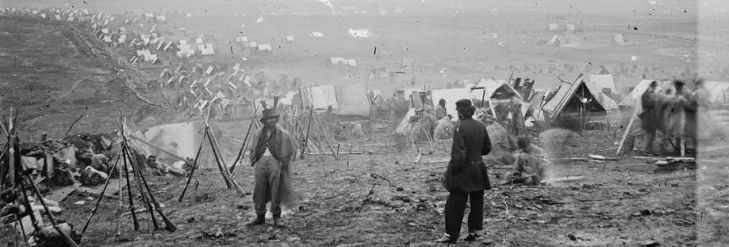
Union soldiers outside Nashville, TN. Winter 1864. (Library of Congress)
Union soldiers outside Nashville, TN. Winter 1864. As the war progressed the Confederacy began to run low on supplies and food, and their camps suffered while Union might, supplies, and transportation facilitated more comfortable winter for their soldiers. (Library of Congress)

When the war was over, Sam entered into business with his brother Tom Johnson near what became the little town of Johnson City, in the Hill Country. The name came, of course, from the Johnson family which settled the area. “City” implies a much larger town than it was actually was; even today the population of Johnson City is only about 1,500. By 1867, he had married and begun a family, and had also started buying and assembling herds of cattle to drive north on the old Chisholm Trail for sale at the railhead in Abilene, Kansas.

His wife, Eliza Bunton (1849-1917), was a daughter of an influential family in early Texas. One Bunton was a signer of the Texas Declaration of Independence from Mexico, a signer of the Constitution of Texas, a hero of the Battle of San Jacinto (which secured Texas independence), and a member of the first Congress of Texas. Her family were wealthy landowners, with a plantation and numerous slaves in earlier days. And her mother, Priscilla Bunton, was the first Christadelphian in her immediate family, and the first person buried in what is now the Johnson family cemetery on the Johnson Ranch.

Eliza Bunton Johnson is remembered as a beautiful young woman, with raven hair and piercing dark eyes. She was tall and regal in bearing, an intelligent and educated woman of refinement. Despite her well-to-do background, she became a quintessential pioneer woman, tireless, hardworking, and always ready to care for others — as was so important for people living on the Texas frontier in dangerous times. Eventually, she and Sam had nine children, six of whom were baptized as Christadelphians.

Johnson Settlement
This is the cabin built by Sam Johnson, Sr., when he and Eliza first settled in the area that became Johnson City. In the basement this cabin, Eliza hid herself and her baby daughter while Indians raided the house.

In the beginning of the settlement, Sam Johnson was also required by circumstances to be an Indian fighter. This territory was on the very edge of civilization, and the Indian tribes still encroached here and there. (In fairness, it should be said that the Indians must have felt that the white men were the ones who encroached on their territory.) In 1869, after a particular raid by Indian warriors in which some neighbors were killed, Sam and other men of the area set out to track down the Indian party, leaving Sam’s wife Eliza and infant daughter Mary home alone. When other hostile Indians approached the farmhouse, Eliza took her baby and hid them both in the cellar. Once in the cellar, she used a pre-set wire to pull a rug over the trapdoor to hide their whereabouts. She used a diaper to stifle the baby’s cries, while the Indians ransacked the house. The very site where this happened can still be seen today.

Crow-War-Party
Eight Crow Indians on horseback, silhouetted on the top of a hill. The American-Indian wars took place from the 1600’s to early 1900’s.

As a small child, I was always especially interested in this story, since Eliza Johnson was my great-grandmother, and another of her daughters, my grandmother Jessie, was scripturally speaking still in the loins of her father (cp Heb 7:5,10), and the womb of her mother, at that time. The reader may well imagine how I felt, when it dawned on me that Eliza’s survival of the Indian attack was crucial to my own existence too. Since Grandma hadn’t been born yet, Mom couldn’t have been born either, and I was a long, long way from seeing the light of day — so there was a lot riding on that diaper keeping the baby quiet. Every time thereafter when I heard the same story, I listened intently to be sure that it turned out the same way. When it did each time, I was always relieved. The same ending each time seemed to confirm to me that everything was working out well, so far!

Sam and Eliza and Eliza’s mother Priscilla were converted to the truth and baptized, probably in 1879, through listening to debates between the traveling brother Oatman and local preachers. This is reported from Webberville, Texas, by W.A. Oatman in The Christadelphian for January 1880. Webberville still exists as a very small community just east of Austin.

Sam is said to have waited patiently through several nights of discussions, wondering when his preacher (from the “Disciples of Christ”, now known as “Church of Christ”) was going to bring out his best arguments and demolish this Christadelphian “heretic”. Finally, however, he realized that no more arguments were forthcoming. So he sought out brother Oatman and said, “Please show me what the Bible really teaches.”
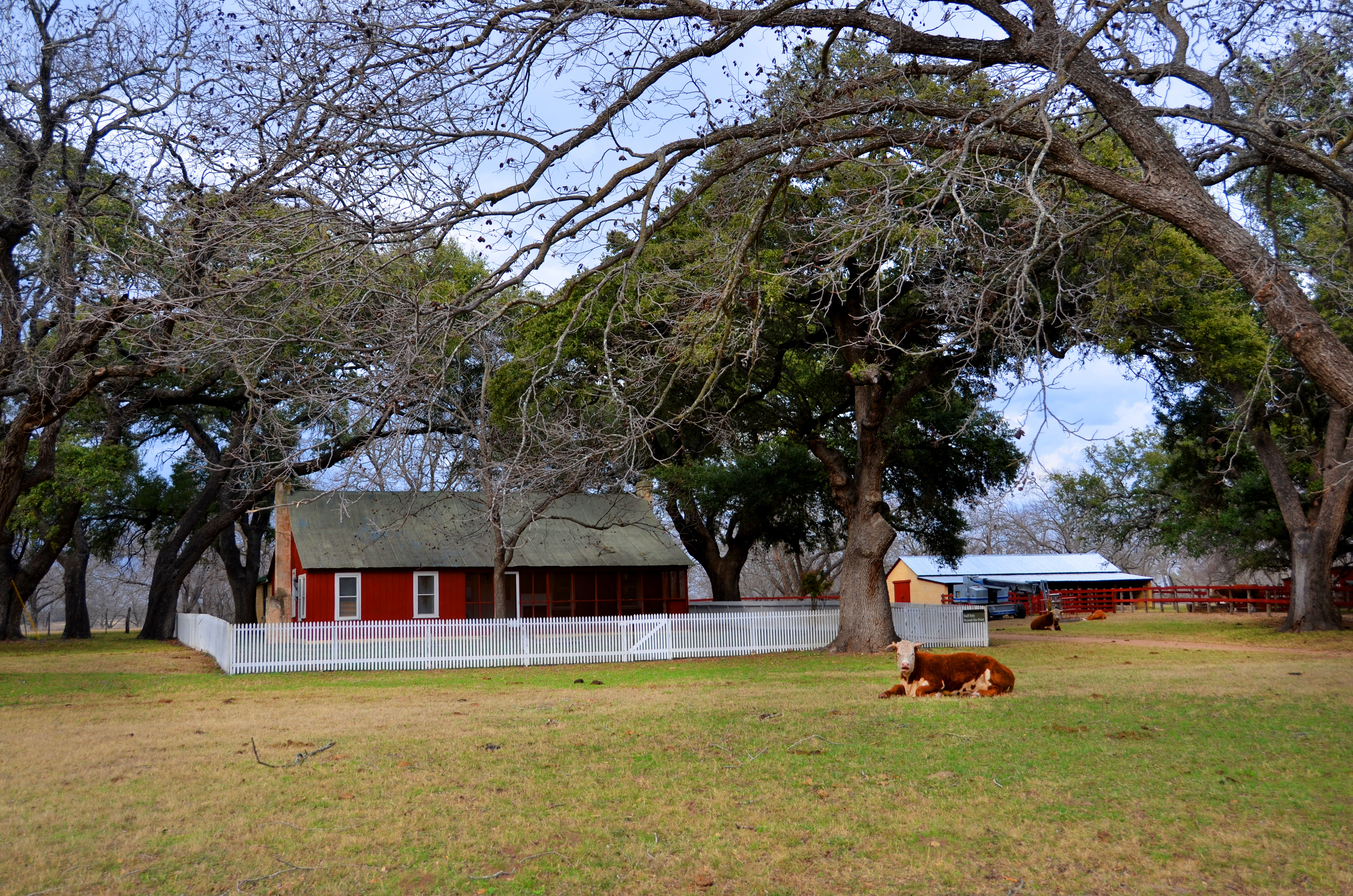
This is where my great-grandparents, Sam and Eliza Johnson, spent their last years. It is also on the Johnson Ranch property, and very near the Johnson Family Cemetery.

Sam Johnson was an extraordinary character– one of those men who, with his wife by his side, tamed a frontier wilderness and made it a home. He left a mark on the land and the people who followed. He was a cattle rancher and trail-driver, raising and buying cattle that he and his brother herded north over the cattle trails through Oklahoma and Kansas, to the railhead for shipment to St Louis and Chicago and the big eastern cities. He made a fortune, lost a fortune, and repeated the process again in a highly volatile and risky business. In between, he was active in state politics and campaigned for a seat in the Texas State Legislature, but apparently saw public service as a passing duty to be discharged, not a career.

To be continued.


This post is part of a series authored by brother George Booker. Click here to see all previous posts in the series.

2015 in Review – What a Year!

Wow. What a year 2015 has been!

It can’t be long till our Lord returns.

As we usher in 2016, lets reflect on some of the tremendous events of this past year, events which remind us of Gods sure word of prophecy:


all subheadings


1 – Egypt discovers a Supergiant gas field.

“He shall stretch forth his hand also upon the countries: and the land of Egypt shall not escape. But he shall have power over the treasures of gold and of silver, and over all the precious things of Egypt” – (Daniel 11)

As one brother aptly described it; “This is huge. It’s almost too perfect. It’s what we have been waiting for.” Why is it so significant? Because in Daniel 11, the King of the North invades Egypt to take her precious gold and silver. Until recently, Egypt didn’t seem to have anything that would be of significant value to Russia, but now they do. Putin, who has a doctorate in the “Exploitation of natural resources of the benefit of the Russian economy” will no doubt be intrigued by this discovery.

Articles: Egypt discovers a Supergiant Gas field

2 – Russia moves into Syria to fight terrorism.

“And I will turn thee back, and put hooks into thy jaws, and I will bring thee forth, and all thine army, horses and horsemen, all of them clothed with all sorts of armour, even a great company with bucklers and shields, all of them handling swords” – (Ezekiel 38)

Ezekiel prophesied (in chapter 38) that Russia would have hooks placed in its jaws, and that it would be dragged down to form a coalition which would eventually come against Israel. There is only one such civilisation infamous for that technique in ancient history, that is, the ancient Assyrian’s. Today, an Assyrian like power – ISIS – have caused Russia to move south and protect its access to international waters.

Articles: “Hooks in Jaws” = ISIS? | Russia acts to protect Tartus

3 – Turkey shoots down a Russian warplane.

“The Ottoman dynasty must of course be driven out of Europe. The occupation of the Dragon’s throne by a non-catholic royalty is clearly exceptional… Hence the Sultan must be ejected that a dynasty patronizing a high priest who forbids to marry may come in. When there for the Czar gets possession of Constantinople he will not be hostile to the Pope.” – (John Thomas, Anatolia)

The decision to shoot down a Russian war-plane has caused grief for Turkey ever since it happened. Russia responded with a range of economic, geopolitical and military measures and threats which have aggravated Turkey and only escalated the rift. Based on Daniel 11 and other sections of scripture, brother Thomas stipulated that at some point Russia would invade Turkey. The resulting aggression between the two belligerents could well be the beginning of such a conflict.

Articles: Why Russia will take Turkey

4 – Russian airliner crashes over Egypt.

“He shall stretch forth his hand also upon the countries: and the land of Egypt shall not escape.” – (Daniel 11)

Daniel 11 shows that the King of the North will “stretch forth his hand also upon the countries: and the land of Egypt shall not escape.” Ever since the airliner crash, Egypt has continued to deny that the crash was a result of terrorist activity and yet Putin strongly affirms that it is. This divergence could become a sore point for Putin.


2015 Review


1 – Nationalism Surges in Europe & Russia.

Given this is a phenomena we expect to result from the spirit of the frogs (Revelation 16), one might say that it would be very convenient for me to pick this phrase out of thin air, however, this is not my observation: STRATFOR – a global intelligence firm noted the resurgence in European nationalism during 2015. Forbes also noted that Russian nationalism is on the rise, and both Putin and the Russia Orthodox Church are directly contributing to this.

Articles: Forbes on Russian Nationalism | STRATFOR on European Nationalism

2 – Israeli / Palestinian Conflict

This has been a significant theme since the United Nations summit when Abbas (the Palestinian President) threatened to do something which could be cataclysmic. Around that time, clashes began on the temple mount in Jerusalem and since then the crisis has continued. The United Nations responded by offering to put international troops in Jerusalem to curb the crisis. Zech 12 speaks of a time when Jerusalem will be a “cup of trembling unto all the people round about… and in that day will I make Jerusalem a burdensome stone for all people”. Joel reminds us “behold, in those days, and in that time, when I shall bring again the captivity of Judah and Jerusalem, (our time – the return of Israel back to their land) – I will also gather all nations”. Today, we can see the gathering of nations in Syria, while a few hundred miles south, in Jerusalem, a conflict is brewing.

Articles: UN offer to install peacekeepers in Jerusalem

 3 – Russia seeks global intervention & control (not just Syria)

2015 can be remembered as the year when Putin sought to occupy and/or control not only all territories which belonged to the ancient King of the North (Iraq, Iran, Pakistan, Afghanistan) but also started to re-establish ties with the nations of the coalition of Ezekiel 38; Libya and Sudan (ancient Ethiopia). This is a discreet but significant development, and it is timed with Russia’s move south into Syria. Ezekiel 38 talks about the time when Russia will be dragged south in order to form a coalition, and 2015 seems to be the year in which this has begun.

Articles: Libya seeks Russias military help | Sudan & Russia sign 14 cooperation agreements | Putin seeks to occupy Afghanistan | Iraqi MP’s seek to replace the US with Russia |

4 – Contention/fears around the Golan

Debka reports that Israel is extremely nervous about Russian operations on its Golan border. The Golan heights is contested territory with the majority of the international community including Russia asserting that the heights belong to Syria. Infact a few months ago, Russia joined in on international condemnation of Israel for its continued occupation. The discovery of large amounts of oil on the Golan has only exacerbated fears of a conflict. Read about the unfolding story here:

Article: This is what could cause Russia to invade Israel

5 – A Looming Financial Crisis

Numerous predictions by mainstream economic experts of a looming financial crisis. 2015 saw a historical global stock-market hiccup in August when the Dow Jones dropped over 1000 points – the biggest intra-day point drop in history. Since then, the World bank, and other leading global banks have warned of impending global defaults which could contribute to a huge financial crisis. Our lord reminds us in Luke 17, that just before the return of Christ, general prosperity will be widespread. “Likewise also as it was in the days of Lot; they did eat, they drank, they bought, they sold, they planted, they builded; But the same day that Lot went out of Sodom it rained fire and brimstone from heaven, and destroyed them all: Even thus shall it be in the day when the Son of man is revealed.” 

Articles: Warnings from the World Bank | Gundlach: “something is very wrong with the world”


Even so, come, Lord Jesus.


To follow coverage of current events for 2016 (if our Lord has not returned) follow our Facebook page at Facebook.com/WatchYeTherefore. This blog will also continue to cover major events and themes relating to prophecy, as they happen during the year.

Russia and the West Collide

This article is part of a series authored by STRATFOR – a geopolitical intelligence firm that provides strategic analysis and forecasting. For other articles by STRATFOR click here.


Summary

Since its emergence as an organized state, Russia has collided with the West. For over a millennium, the two have clashed economically, politically and militarily, using the countries that form the buffer between them as a staging ground for their rivalry.

With Ukraine’s Euromaidan uprising and Russia’s subsequent annexation of Crimea in March 2014, the long-standing conflict has been renewed. But just as the end of the Cold War did not resolve hostilities between Russia and the West, neither will a resolution to the Ukrainian crisis erase the fundamental imperatives that have pitted the two against each other for more than a thousand years.

Analysis

The Russia-West divide began when the kingdom of Kievan Rus, the Slavic precursor to the modern Russian state, arose in Eastern Europe in the ninth century. With territory stretching from the Baltic Sea to the Black Sea, Kievan Rus was one of medieval Europe’s largest states. Toward the end of the 10th century, the kingdom adopted Orthodox Christianity as its official religion, opening a rift between itself and its Catholic neighbors in Western Europe and laying the groundwork for future contention between East and West.

A few centuries later, the Mongols invaded and destroyed Kievan Rus, and the state’s center of power shifted from Kiev to Moscow. The city became the heart of the Grand Duchy of Muscovy, a rising Orthodox and Slavic power that amassed its strength and territory during the 14th and 15th centuries. Meanwhile, Kiev (and much of modern-day Ukraine) became part of Catholic Poland and Lithuania, forging a lasting bond with the West.

The Rise of the Russian State

The Grand Duchy of Muscovy continued to expand and transform, first into the Tsardom of Russia in the 16th century and then into the Russian Empire by the early 18th century. Few geographic barriers stood between it and mainland Europe except vast and empty plains. And so, the empire extended its borders westward, vying with Poland, Sweden and Austria for territory in Eastern and Central Europe. By the start of the 19th century, Russia had become as powerful as many of Europe’s strongest states.

But the lack of geographic barriers surrounding it also made the Russian Empire vulnerable. It needed to create space between itself and other formidable powers, and it did so by spreading its influence in the territories on its periphery. The empire gradually and systematically took control of Siberia, the Caucasus and Central Asia. This brought the Russians into both contact and conflict with Muslim and Asiatic powers such as the Ottomans and Persians, as well as the European powers that held substantial sway in those territories, giving rise to great-power rivalries like the Great Game. As Russia evolved, so did its rivalry with Europe.

Then, at the start of the 20th century, something changed. The United States emerged on the international stage as a new global power, and the dynamics of the Russia-Europe conflict shifted. For the first time, a power that was not of the region played a significant role in its politics, first in World War I and then again in World War II. The competition between Russia and the West became an international one whose significance extended well beyond its geographic borders.

By the end of World War II, Russia’s influence on the Continent had spread farther than ever, reaching as far west as Berlin. In response, the West formed a new strategy to halt the Soviet Union’s spread: containment. Spearheaded by the United States, the strategy applied not only to Russia’s presence in Europe but also to its activities around the globe. The competition took on global proportions during the Cold War, with its participants divided into two diametrically opposed political and military blocs: the Warsaw Pact and NATO.

The Past 25 Years: A Rivalry Revived

Although the collapse of the Soviet Union in the early 1990s marked the end of the Cold War, it did not signal an end to the broader dispute between Russia and the West. At first, though, all evidence seemed to point to the contrary: Talk arose of incorporating Russia into Europe and the Western alliance, and it even appeared to be feasible. Moscow had lost its Eurasian empire, and the new Russian Federation had embraced democracy and capitalism, at least initially.

But the transition proved so chaotic and painful for Russia that, within a decade, the state began to recentralize power as Boris Yeltsin left the presidency and Vladimir Putin assumed it. The 1990s, celebrated by the United States and Western Europe as a golden age of Russian economic growth and democracy, were lamented by Russian leaders and much of the public as a catastrophe.

In its weakened state, Russia no longer needed to be actively and overtly contained by the West, and tensions between the two tapered off temporarily. However, the geopolitical imperative underpinning the United States’ containment policy — blocking the rise of regional hegemons on the Eurasian landmass that could challenge the Western alliance structure — never disappeared. Thus, NATO and the European Union continued to expand. Meanwhile, Russia recovered and Putin consolidated his power. The Kremlin worked to regain its position in the former Soviet periphery. On a rising tide of high energy prices and political stability, Russia began to re-emerge as a regional power.

Russia’s resurgence reignited the conflict between it and the West. The two fought for the allegiance of states in the former Soviet periphery, most clearly in the 2008 Russo-Georgian War, when Russia invaded Georgia after it and Ukraine attempted to join the Western alliance structure, particularly NATO. The European Union responded by launching the Eastern Partnership program in 2009, with the goal of strengthening economic and political ties with former Soviet states. In 2010, Russia countered with its own integration program, the Customs Union.

The rival blocs sought to attract countries in the Eurasian borderlands, perhaps the most contested of which was Ukraine. When, in November 2013, Kiev refused to sign an EU association agreement, the cornerstone of the Eastern Partnership program, protests erupted that ultimately transformed into the Euromaidan revolution of 2014. The situation quickly deteriorated, as Russia annexed Crimea and lent its support to the pro-Russia rebellion in Ukraine’s east.

Since then, hostilities between Russia and the West have intensified, reaching levels not seen since the Cold War. With a proxy conflict in Ukraine, Western sanctions and Russian countersanctions, and military buildups on both sides, it is clear that the Russia-West confrontation has once again come to a head.

The Next 25 Years: Same Conflict, Different Shape

Less clear is the shape that the Russia-West confrontation will take in the coming years. The geopolitical imperatives that form the conflict’s foundations will remain intact, as will the cultural differences that have spurred their competition in the Eurasian borderlands. But many changes are on the horizon as well, some of which could shift the balance of power in the West’s favor.

One such change is the massive demographic shift that is underway in Russia, Europe and the former Soviet periphery. By 2050, U.N. demographic projections expect Russia’s population to decline from 143 million to 129 million, a loss of nearly 10 percent. The West, by comparison, has a more favorable outlook: The United States’ population will grow by over 20 percent, from 322 million to 389 million, while Europe’s largest countries will end up somewhere in between Russia and the United States over the same period. Germany’s population will shrink by 7 percent, from 81 million to 75 million; France’s population will grow by 11 percent, from 64 million to 71 million; and the United Kingdom’s population will rise by 15 percent, from 65 million to 75 million. Each of these trends will shape the economic and military standing of their respective countries over the next 25 years.

Consequently, Russia’s ability to challenge the West by projecting its economic and military power will likely decline in the coming decades. Of course, demographic growth does not directly equate to the projection of power, and the West (particularly Europe) will experience challenges stemming from immigration and high non-European birth rates. Still, Russia’s relatively steep demographic plunge can be expected to undermine its ability to influence its former Soviet neighbors. This will only become truer with each year that passes since the Soviet Union’s collapse, as the social and cultural bonds that tie Russia to its periphery continue to weaken.

This is not to say Russia’s influence in the Eurasian borderlands will evaporate completely. Russia has been the dominant foreign power in the region for centuries, and its position has withstood serious challenges and periods of dramatic upheaval. Thus, Moscow’s primary challenge in the next 25 years will be to figure out how to maintain its advantage in the former Soviet periphery as its resources decline and the cultural and political ties underpinning its position erode.

The West will likely face its own challenges in the years ahead. A shift toward greater regionalization is already underway in Europe, and it will likely intensify in the next 25 years as groupings of states with shared political and cultural characteristics overtake the Cold War-era institutions of the European Union and, to a lesser extent, NATO. This does not mean the two will collapse entirely. Instead, they will likely be reshaped into more practical and sustainable forms. Nor will it necessarily lead to a power vacuum in Europe that Russia could exploit. In fact, it may allow some European countries to better deter Russian aggression. Nevertheless, the format and manner in which the West can challenge Moscow will almost certainly change.

These are the broad strokes that together start to shape the Eurasian borderlands’ future. Though other factors, including technological developments and the emergence of new political ideologies, will no doubt shape the Russia-West confrontation as well, by nature they are more difficult to predict. In this series, Stratfor will explore how the rivalry between Russia and the West has played out in Ukraine, Eastern Europe, the Caucasus and Central Asia prior to and since the collapse of the Soviet Union. We will then forecast how it is likely to change in each region over the next 25 years — a period that is poised to be just as dynamic, as both sides prepare for the sweeping changes ahead.

Lead Analyst: Eugene Chausovsky

Part 3: The First Texas Christadelphians

Continued from Part 2…

It was into this vast and beautiful land that the first Texas Christadelphians came in 1850. But at that time they weren’t even known as Christadelphians, because John Thomas hadn’t coined that special name yet.

It is their story that I now remember.

John Oatman was born in Kentucky in 1787, and moved first to Indiana, where he married. Later he and his family moved to Illinois, finally settling in the community of Dundee. It was in Illinois that he would meet and have discussions with Dr. John Thomas about the truth of the gospel as expounded in his book Elpis Israel, “the Hope of Israel”. Soon he committed himself to the gospel of Christ, and was baptized.

The Oatman family moved to Texas in 1850, stopping first in Bastrop County, in the more settled land just east of the Hill Country. John and his sons were very soon preaching the gospel to all who would listen, often holding debates with ministers who challenged their teachings. In those days, entertainment of any sort was in short supply in small Texas towns, and such Bible discussions were assured of large turnouts. Over the years many families in central Texas learned the Truth in that way.

While some members of the Oatman family stayed in Bastrop County, most of them moved on to Llano County, 100 miles further west, in the center of the Hill Country. Their preaching extended to much of the surrounding areas. They reported their progress to John Thomas and their letters appeared in his monthly magazine, The Herald of the Kingdom and Age to Come.

Notable among the sons of John Oatman was Clement Oatman, a very effective debater and teacher.

civil war_0
1864: Troops stand next to the United States flag during the Civil war.

The Civil War (1861-1865) and the resulting unrest on the frontier impeded preaching. People in the Texas Hill Country were divided in their allegiance -– leading to some violence between political factions –- and the Indians took advantage of the situation by staging a number of raids. It was a dangerous time, and gospel proclamation was not very effective; in fact, a number of converts fell away. But after the war’s end the brothers’ efforts resumed, and there was much fruit.

Citizens of Llano, Texas, honor the memory of John Oatman and the Oatman family as early settlers of the county, but their biography of “Elder” John fails to mention anything about his teachings. It simply states that “John Oatman, Sr., was an active minister of the gospel for 40 years, always refusing remuneration for his services.” John Oatman was already of advanced years when he arrived in Texas, and he fell asleep in 1875. During his last years, he was able to witness the beginnings of the Christadelphian community in Texas.

Then there were the Johnsons. Alan Eyre, in his book The Protestors, has this paragraph:

The brothers Oatman, rugged individualists both, rode the range on the Texas frontier years before the cowboys and Indians had finished scuffling, “traveled the length and breadth of the state”, held debates and camp meetings, and are reported to have baptized “a hundred men and women with their own hands”, including forebears [ancestors] and relatives of former President Lyndon B. Johnson.
Page 202

Soon these Oatman pioneers and preachers were ably assisted by some of their converts. Among the earliest converts were members of the Banta family, and several of this first generation of Bantas worked alongside the Oatmans in their proclamation work. Both these names (and especially the Banta name) survive today among Texas Christadelphians. In fact, with some of the earliest families of Oatmans and Bantas producing many children, and with the inclination of Christadelphians to marry other Christadelphians, it is possible that practically every Texas Christadelphian with long roots in the Truth is actually related by blood to these faithful men and women.

At least one of these Oatman brothers was a doctor. In the 1870s, the rugged Hill Country of southwest Texas was so under-populated that it was served rather haphazardly by traveling doctors. What one did if he or she needed a doctor quickly probably doesn’t bear thinking about. Of course, those medical procedures considered “simple”, like childbirth, were often handled by local midwives.

This is the birthplace of Lyndon Johnson, on the ranch near the Texas White House and the Johnson Family Cemetery. It is part of the parks services also.

My grandmother, Jessie Johnson Hatcher, was present at the birth of the future President, Lyndon Johnson, in 1908. She said that her nephew was actually delivered by a neighbor who was a midwife, since the nearest doctor couldn’t get across the Pedernales River, in flood stage after heavy Hill Country rains. She said further that, when the doctor finally arrived only to be told that he was too late and the baby had already been delivered by Mrs. Lindig, the doctor just laughed and said, “Why, she’s just as fine a doctor as I am!” Which may actually have been true.

To be continued.


This post is part of a series authored by brother George Booker. Click here to see all previous posts in the series.

Libya seeks Russia’s military help

Republished with permission from Sputnik (Russian state owned news agency).

The Libyan Armed Forces’ Commander Brigadier General Khalifa Hafter has voiced his country’s readiness to cooperate with Russia in fighting terrorism, according to the Iranian news agency FARS.

“We welcome support from Russia in fighting terrorism,” the agency quotes Hafter as telling reporters after his meeting with United Nations Support Mission in Libya (UNSMIL) Chief Martin Kobler in the city of Marj, Northeastern Libya.

The military leader assured that if Russia proposes a plan for fighting terrorism in Libya, Tripoli will cooperate with Moscow, adding that “Russians are serious in [the] fight against terrorists”.

Libya is currently run by two main rival governments, which are entangled in a violent, nationwide power struggle. Each side is backed by powerful armed groups which have dominated the Libyan scene since the elimination of the country’s former leader Muammar Gaddafi in 2011.

The country’s capital Tripoli, is controlled by a political faction, known as the General National Congress, which was set up after an armed group called Libya Dawn seized the capital, Tripoli, last summer.

The UN-recognized government of Prime Minister Abdullah al-Thinni is based in the eastern city of Bayda; its elected parliament moved from the capital Tripoli to Tobruk.

On Thursday, rival Libyan politicians signed a deal on a unity government despite opposition on both sides, in what the United Nations described as a “first step” towards ending the crisis.

World powers have urged the warring factions to break a political deadlock that has allowed jihadists and people-smugglers to flourish.

Meanwhile, the jihadist group Daesh (also known as ISIL/ISIS) has increased its presence in the Libyan Mediterranean city of Sirte, having apparently established its new base there, where it can “generate oil revenue and plan terror attacks”.

Related Posts: