Russian forces fire at Israeli Aircraft

Reuters Reports:

Russian forces in Syria have fired at least twice on Israeli military aircraft, prompting Prime Minister Benjamin Netanyahu to seek improved operational coordination with Moscow, Israel’s top-selling newspaper said on Friday.

The unsourced report in Yedioth Ahronoth gave no dates or locations for the incidents nor any indication Israeli planes were hit. Russia mounted its military intervention in Syria in September to shore Damascus up amid a now 5-year-old rebellion.

Separately, Israel’s Channel 10 TV said a Russian warplane approached an Israeli warplane off the Mediterranean coast of Syria last week but that there was no contact between them.

An Israeli military spokesman declined comment. Netanyahu’s office and the Russian embassy in Israel did not immediately respond.

srael, which has repeatedly bombed Syria to foil suspected arms handovers to Lebanese Hezbollah guerrillas, was quick to set up an operational hotline with Moscow designed to avoid accidentally trading fire with Russian interventionary forces.

Visiting Moscow on Thursday, Netanyahu told Russian President Vladimir Putin in televised remarks: “I came here with one main goal – to strengthen the security coordination between us so as to avoid mishaps, misunderstandings and unnecessary confrontations.”

In an apparent allusion to Syria, Putin said: “I think there are understandable reasons for these intensive contacts (with Israel), given the complicated situation in the region.”

According to Yedioth, the reported Russian fire on Israeli planes was first raised with Putin by Israeli President Reuven Rivlin, who visited Moscow on March 15. At the time, Putin responded that he was unaware of the incidents, Yedioth said.


“Be ready and keep ready, you and all your hosts that are assembled about you, and be a guard for them.

After many days you will be mustered. In the latter years you will go against the land that is restored from war, the land whose people were gathered from many peoples upon the mountains of Israel, which had been a continual waste. Its people were brought out from the peoples and now dwell securely, all of them.

You will advance, coming on like a storm. You will be like a cloud covering the land, you and all your hordes, and many peoples with you.”

Ezekiel 38


Russia’s so called withdrawal from Syria

In 2015 Russia surprised the world when it committed Russian troops and military hardware to defend the Assad regime in Syria.  With Russian assistance the Assad government was able to make substantial gains against the various rebel forces who had been threatening it.

Russia caught the world off guard again in March 2016 when it announced that its forces would be withdrawing from Syria.  Exactly what “withdrawal” means is hard to define.  It is true that many of the 4,000 ground forces that had been deployed have returned to Russia, but it also is clear that the Russians will continue to operate the airbase it built last year near Latakia as well as the naval base it has long held at Tartus (having inherited it from the former USSR).

Why did Vladimir Putin decide to withdraw (even if only partially) from Syria?  Presumably because he had achieved his objectives from his intervention.  And what has Russia achieved?  Firstly, it has saved the Assad regime, at least for the time being.  Secondly and more importantly, Putin has restored Russia’s superpower status by demonstrating its resolve to extend its geo-political reach into the Middle East.  Thirdly, Russia has frustrated the ambitions of Iran, Turkey and Saudi Arabia to be the patrons of a reconstructed Syria.

It is clear that the Assad regime cannot hope to retain its hold on Syria in the long term; Russia’s involvement has ensured it will play a key role in determining who fills the vacuum when, finally, there is regime change in Syria.

While the United States and her allies vacillated with regard to Syria, Russia took decisive action which changed the course of the Syrian civil war.  In an article by Amotz Asa-el entitled “Russia’s Retreat? in the April 2016 issue of the Australia/Israel Review he made this observation which resonates with the scenario outlined in Ezekiel 38:

The region-wide impression that Moscow initiates and Washington responds, that the Kremlin impacts while the White House talks, and that Russia does not abandon allies the way Obama abandoned Egypt’s Hosni Mubarek, will constitute a major diplomatic challenge for the next American President.

While Israel has benefited from neutralisation of the Syrian army as a threat there is no guarantee that the forces which replace the Assad regime in Syria will be any more well disposed towards Israel than the current regime.  Israel has watched events in Syria closely to ensure that they do not impact adversely upon the Jewish state, and intervened at times when necessary to protect her interests.  She has also benefited from the Syrian civil war in terms of her regional position, in particular those nations which Ezekiel 38 indicates will be allied with Tarshish at the time of the end.  Amotz Asa-el made the point that, as a result of the Syrian civil war:

Egypt, Jordan and the Gulf states appreciate Israel as a regional stabiliser, and as an ally in their confrontation with Islamism.  The war also made Ankara reconsider its anti-Israel U-turn last decade …

Putin’s involvement in Syria has, however, impressed upon Israel the fact that its relationship with Russia is now more critical and sensitive than it has ever been.  In that context it is interesting to note Israel’s reticence to criticise Russia’s intrusions into the Ukraine.  It also is interesting to see Russia’s continued interest in seeking to help Israel in its exploitation of the major oil and gas fields recently identified off the Israeli coast.  Perhaps most remarkably, Israel now regards Russia as potential peace broker with her enemies in the Middle East.

A mere 48 hours after Russia announced its “withdrawal” from Syria, President Rivlin of Israel made an unscheduled visit to Moscow, postponing a previously arranged visit to Australia to facilitate the trip.  At that meeting Russia agreed to two requests from Israel:

  1. That Russia continue its co-ordination with the Israeli Defence Force with regard to operations in Syria; and
  2. That Russia work to restore the UN peace keeping force that, prior to the Syrian civil war, helped to maintain stability on the Syrian-Israeli border.

Amotz Asa-el concluded his article with this paragraph:

The role of peacemaker which Putin is now in a position to play is hardly what his international image currently evokes.  Nonetheless, the world opinion that does not expect him to pacify enemies is the same world opinion that did not expect him to intervene in Syria last year, or to retreat from it now.

Russia has demonstrated its capacity and willingness to intervene in long-running internecine conflict in the Middle East.  It is not hard to imagine how Russia’s intervention in Syria could be repeated in the near future a little further south.  When she does, we might expect from the terms of Ezekie 38 that the powers opposed to Russia will be as flat-footed and muted in their response as they have been in the case of Syria.


Related Articles:

Putin agrees to take the Golan from Israel, and give it to Syria

Last year we wrote a post explaining what could cause Russia to invade Israel.

At the time, Israel’s Prime Minister had flown to Washington, and was making a desperate bid to get Obama’s support for Israeli sovereignty over the Golan Heights.

Only a few weeks earlier a discovery had been made that would serve to increase tensions on the question of sovereignty over the Golan – huge oil deposits were found on the Golan Heights, and verified by an Israeli company.

Yet, weeks later, Benjamin Netanyahu returned to Israel having failed to secure Obamas support.

It wasnt long before the United Nations – including Russia – condemned Israels “occupation” of the Golan Heights, and around the same time, Syria asked Russia to develop their oil resources.

Then, over the course of the next 6 months, the Israeli leadership became very concerned about Russian activity near the Golan.

Click here for the context of the story thus far.

Now, Debkafile reports the following:


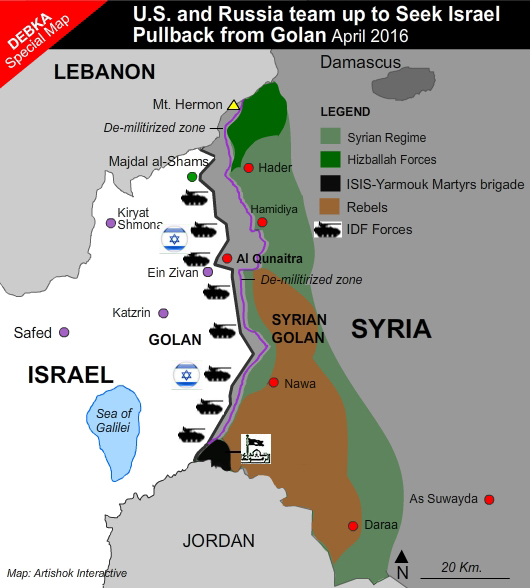
“Prime Minister Benyamin Netanyahu will visit Moscow on Thursday, April 21 to meet with Russian President Vladimir Putin and to launch the most important battle of his political career, and one of Israel’s most decisive contests of the last 10 years: the battle over the future of the Golan Heights.

DEBKAfile’s intelligence sources and its sources in Moscow report exclusively that Israel’s top political leaders and military commanders were stunned and shocked last weekend when they found out that US President Barack Obama and Russian President Vladimir Putin have agreed to support the return of the Golan to Syria. The two presidents gave their top diplomats, Secretary of State John Kerry and Foreign Minister Sergei Lavrov, the green light to include such a clause in a proposal being drafted at the Geneva conference on ending the Syrian civil war.

Israel captured the Golan from the Syrian army 49 years ago, during the Six-Day War in 1967 after the Syrian army invaded Israel.

In 1981, during the tenure of then Prime Minister Menachem Begin, Israel passed a law defining the Golan as a territory under Israeli sovereignty. However, it did not state that the area belongs to Israel.

While Israel was preparing for a diplomatic battle over the future of Jerusalem, Judea and Samaria, Obama and Putin decided to deal a diplomatic blow to Israel and Netanyahu’s government on an unexpected issue, the Golan.

It is part of an endeavor by the two powers to use their diplomatic and military cooperation regarding Syria to impose agreements on neighboring countries, such as Israel, Turkey, Saudi Arabia and Jordan.
1

For example, Washington and Moscow are trying to impose an agreement regarding the granting of independence to Syrian Kurds, despite Ankara’s adamant opposition. The two presidents are also pressuring Riyadh and Amman to accept the continuation of Syrian President Bashar Assad’s rule, at least for the immediate future.

DEBKAfile’s sources report that just like the other diplomatic or military steps initiated by Obama and Putin in Syria, such as those for Assad’s eventual removal from power, the two powers see a resolution of the Golan issue as a gradual process that may take a long time, perhaps even years. But as far as they are concerned, Israel will have to withdraw from the Golan at the end of that process.

It should be noted that Prime Minister Netanyahu is not traveling to Washington to discuss the Golan issue with Obama. The frequent trips by the prime minister, senior officials and top IDF brass to Moscow in recent months show where the winds are blowing in the Middle East.

However, Moscow is not Washington, and Israel has no lobby in the Russian capital defending its interests.

It should be made very clear that the frequent trips by senior Israeli officials to Moscow have not created an Israeli policy that can influence Putin or other senior members of the Russian leadership. Putin has made occasional concessions to Israel on matters of minimal strategic importance, but on diplomatic and military steps regarding Syria and Iran he has shown little consideration of Jerusalem’s stance.

It should also be noted that there has been no basis for the enthusiasm over the Russian intervention in Syria shown by Netanyahu, Israeli ministers and senior IDF officers.

All of the calls by a number of Russia experts, mainly those of DEBKAfile, for extreme caution in ties with Putin have fallen on deaf ears among the political leadership in Jerusalem and the IDF command in Tel Aviv.

Amid these developments, three regional actors are very pleased by Washington and Moscow’s agreement to demand Israeli withdrawal from the Golan: Syrian President Assad, the Iranian leadership in Tehran and Hizballah leader Hassan Nasrallah.

Now, they do not need to risk a military confrontation with Israel over the Golan because Obama and Putin have essentially agreed to do the dirty work for them.
Russian Prime Minister warns of “A New World War” – this time in the Middle East

As Turkey and Saudi Arabia edge closer to sending ground forces into Syria at the behest of the United States, Russian Prime Minister Dmitry Medvedev has warned that an escalation of the conflict could lead to ‘World War’.

During an interview with German newspaper Handelsblatt, Medvedev warned of dire consequences if the United States and its allies abandon Syrian peace talks in favor of deploying ground forces.

Saudi security forces, whose faces display the word ‘Decisive’ take part in a military parade. Turkey Plans Joint War Games With Saudi Arabia. © AP PHOTO/ MOSA’AB ELSHAMY.
“All ground operations, as a rule, lead to permanent wars,” he said. “Look at what is going on in Afghanistan and a number of other countries. I don’t even mention the ill-fated Libya.

“The Americans must consider — both the US president and our Arab partners — whether or not they want a permanent war.”

All sides should instead focus on implementing peace talks.

“We must make everyone sit down to the negotiating table, and we can do it by using, among other things, the harsh measures that are being implemented by Russia, the Americans, and even, with all reservations, the Turks, rather than start yet another war in the world.”

Flags wave in front of soldiers who take positions with their army vehicles during the NATO Noble Jump exercise on a training range near Swietoszow Zagan, Poland
 Any direct involvement by foreign players on behalf of the Syrian opposition will only worsen the violence.

“We may differ in our opinions of certain political leaders but it is not a good enough reason to begin intervention or to stir up unrest from within.”

Moscow has long-stressed the need to support the legitimate government of President Bashar al-Assad in the fight against terrorism. Working alongside the Syrian Army, Russian airstrikes have had a severe impact on Daesh, also known as IS/Islamic State.

“…We must sit down at the same table, but our partners avoid this,” Medvedev said. “That is, there have been some occasional meetings, telephone conversations and contacts between our militaries. But in this situation we should create a full-scale alliance to fight this evil.”

Migrants, mostly from Syria, headed for EU member Hungary, walk in groups towards Hungary in Kanjiza, North Serbia, near the Hungarian border. © AP PHOTO/ EDVARD MOLNAR.
The Prime Minister also criticized Europe’s handling of the migrant crisis. The continent is facing an increased risk of terrorist attack because of its decision to open its borders, and this only highlights the need for international cooperation against terrorism.

“Some of these people — and it’s not just a few strange individuals or utter scoundrels, but hundreds and possibly thousands — are entering Europe as potential time bombs, and they will fulfill their missions as robots when they are told to,” he said.

“We are not trying to rule the world or impose our regulations on it, though we are accused regularly of having such ambitions” he added. “That is not so — we are a pragmatic people who realise that no one can shoulder responsibility for the whole world, not even the United States of America.”

Article by Sputnik: http://sputniknews.com/russia/20160212/1034614648/medvedev-syrian-permanent-war.html#ixzz3zuSgodpO

Putin allows terrorists onto the Golan border – breaking his promise to Israel

A large Hezbollah force has entered the southern Syrian town of Daraa, a critically dangerous event for Israel’s security.

The way to the town, which lies near the Jordanian border and across from the Israeli Golan, was opened before Hizballah by none other than Russian forces. This was a blatant violation of President Vladimir Putin’s commitments to Prime Minister Binyamin Netanyahu and Jordanian King Abdullah not to permit Iranian and Iran-backed forces, such as Hizballah and Iraqi and Afghani Shiite militias, reach their borders in consequence of Russia’s military intervention in the Syria war.

Daraa is just 32 km from the southern Golan and 12 km from the Jordanian border. Hizballah forces in this town are therefore within easy striking distance from northern Israeli and Jordan.

What happened Wednesday was that a sizeable Hizballah contingent made it into Daraa, the day after a Syrian unit under the command of Russian officers captured the town of Sheikh Maskin, cutting off rebel forces east of Daraa from their comrades to the west. Control of Sheikh Maskin is the key to the crossroads leading to Damascus in the north, the Druze Mountain town of es-Suwaida in the east, and Quneitra on Golan opposite Israel’s northern defenses.

The battle for Sheikh Maskin was the first in the Syrian conflict to be directly fought under Russian command. Its fall sparked accounts of Russian officers commanding Syrian troops in different parts of Syria.

So far, Israel has not reacted to the Hizballah force’s advance, notwithstanding public statements by Prime Minister Binyamin Netanyahu and Defense Minister Moshe Ya’alon that this would never be allowed to happen.

DEBKAfile’s military sources explain this reticence by a persistent misreading of the Syrian crisis in the higher ranks of the Israeli defense establishment. Military Intelligence chief Maj. Gen. Herzl Halevi, who has a good grasp of its complexities, is a lone voice against the defense minister and IDF chief of staff, Lt. Gen. Gady Eisenkot

In Amman, however, King Abdullah and his generals signified both alarm and fury. DEBKAfile’s sources report that Wednesday morning, the king shot off an urgent message to President Putin demanding an explanation for the Russian officers’ action in opening the door of Daraa to hostile Hizballah fighters.

Jordan has fought Hizballah and its conspiracies for three years, ever since its security forces seized an arms cache that Hizballah had smuggled into the kingdom for a terror cell to mount attacks in the northern province of Irbid. Amman is now concerned that Hizballah is close enough to make a grab for Al-Ramtha, the only border crossing between Syria and Jordan. That would be a feather in the cap of Iran’s Lebanese proxy, as the first Arab border crossing to fall to a Hizballah force outside Lebanon, and one, moreover, located athwart a main regional water source, the Yarmouk River.

As of Thursday morning, Jan. 28, Abdullah had not received a reply to his missive from Putin, but a message did come through to Amman from Syrian President Bashar Assad.

Using a back-door intelligence channel, he sent a notice in the name of Gen. Bahjat Suleiman, former Syrian ambassador to Jordan until he was expelled in May 2014, that King Abdullah must now face the consequences of his long support for the rebels of southern Syria.

The monarch was also advised to prepare for the influx of thousands of fleeing rebel fighters whom the combined Syrian and Hizballah forces were pushing towards the Jordanian border.

The next hours will be critical for the development of a similar crisis on the Israel-Syrian border in the Golan region.

The risk of a confrontation on the Golan is already high – click here to find out about the context behind this crisis.

This article was originally published on DEBKA