This article is part of a series authored by STRATFOR – a geopolitical intelligence firm that provides strategic analysis and forecasting. For other articles by Stratfor click here.
Last October, when Russia had just begun its military intervention in Syria, U.S. President Barack Obama spurned the idea that Russia could challenge U.S. leadership in the Middle East. In a 60 Minutes interview, he said, “Mr. Putin is devoting his own troops, his own military, just to barely hold together by a thread his sole ally. The fact that they had to do this is not an indication of strength; it’s an indication that their strategy did not work.” Two months later, as Russia’s military presence in Syria deepened further, Obama remained dismissive of Putin’s strategy, noting that “with Afghanistan fresh in the memory, for him [Putin] to simply get bogged down in an inconclusive and paralyzing civil conflict is not the outcome that he is looking for.”
Washington can continue to underestimate Russia at its own peril. Russia has indeed poured resources into a maddeningly inconclusive conflict, but so has the United States and so will others who cannot be tempted away from the geopolitical proxy battleground complicated by the presence of jihadists. The problem is that the layers to Russia’s strategy tend to be too dense for the Western eye. For Russia, the Syrian battleground is not about propping up an ally through reckless spending, nor is it simply about pursuing an alternative strategy to defeat the Islamic State. Syria is a land of opportunity for Russia. This is the arena where self-control, patience and a careful identification and exploitation of its opponents’ strengths and weaknesses will enable Russia to reset its competition with the West.
Realpolitik, Russian-Style
The Russian economy is staggering amid low oil prices. Kremlin power struggles are intensifying. And social unrest is increasing nationwide. The United States is reinforcing European allies all along Russia’s western flank. This scene does not suggest a perfect record for the Russian leader, but Putin is also a skilled practitioner of realpolitik. Moscow has a sober ruthlessness and resourcefulness that it will employ to try to make up for its most obvious weaknesses.
In Realpolitik: A History, historian John Bew gives credit to an oft-overlooked German politician, August Ludwig von Rochau, for conceptualizing the pragmatism behind this political philosophy. In Foundations of Realpolitik, which Rochau wrote in the mid-19th century during the formative years of the German nation-state, he said, “The Realpolitik does not move in a foggy future, but in the present’s field of vision, it does not consider its task to consist in the realization of ideals, but in the attainment of concrete ends, and it knows, with reservations, to content itself with partial results, if their complete attainment is not achievable for the time being. Ultimately, the Realpolitik is an enemy of all kinds of self-delusion.”
Rochau’s profile of a state run by realpolitik has Putin’s Russia written all over it. Russia’s inherent vulnerabilities may deny it lasting glory, much less the ability to put the brakes on Western encroachment. Moscow will, however, be quick to come to terms with uncomfortable realities and will take what it can get when the opportunity arises.
A skilled opportunist will create the opportunity he or she seeks to exploit. Syria is the contemporary axis of geopolitical conflict. By enabling a loyalist siege on Aleppo, Russia has demanded the attention of Berlin, Washington and Ankara in one fell swoop. Some 100,000 Syrians have fled Aleppo in the past two weeks, and that number could rapidly multiply if the city is besieged.
For German Chancellor Angela Merkel, that means another wave of migrants that will push Europe deeper into crisis as borders snap shut along the Balkan route, nationalist political forces capitalize on fear and unrest driven by the migrant flows, and problematic debtor states in the southern periphery use the crisis to charge back at Berlin and Brussels for burdening them with a refugee crisis while trying to crush them with austerity measures. It is no coincidence that Russia is using every opportunity to endorse and amplify the views of those very same Euroskeptic forces that are giving Merkel and other mainstream politicians in Europe a daily migraine as they warily shift further to the right to remain tolerable to their constituencies.
Putin cannot halt the flow of migrants to Europe, but Russia’s military involvement in Syria does give him the power to increase the pain on Europe. That could prove a useful lever for Russia; using it allows Moscow to divide the Continent and potentially extract a veto from within the bloc on issues such as continuing Russian sanctions and responding to Poland’s request for permanent bases on Europe’s eastern flank.
For U.S. President Barack Obama, the siege on Aleppo represents an attack from all directions. Russia’s attempt to accelerate the fragmentation of Europe undermines a critical network of U.S. allies while creating the potential for much bigger crises on a Continent that, for all its sophistication, is hardly immune to barbaric conflict. As U.S. Secretary of State John Kerry said this past week at the Munich Security Conference, “We in the United States aren’t sitting across the pond thinking somehow we’re immune … America understands the near existential nature of this threat to the politics and fabric of life in Europe.” The White House may understand what lies at stake at the intersection between the European crisis and the Syrian civil war, but it is also less prepared to manage Russia’s role in this meta-conflict.
It is well known that Russia has been bombing many of the rebels whom the United States needs as ground proxies in the fight against the Islamic State. Even at tepid points of negotiation, like the cease-fire announcement that emerged from talks between Kerry and his Russian counterpart, Sergei Lavrov, at Munich this past week, major caveats are created for Russia to exploit. While playing the role of the diplomat and shuttling between capitals to organize peace talks over Syria, Russia can continue bombing at will, claiming that it is targeting Jabhat al-Nusra and other targets on its black list. And so long as Russia can play the role of the spoiler, the United States will lumber along in the fight against the Islamic State in Syria at a frustratingly slow pace.
Playing the Kurdish Card
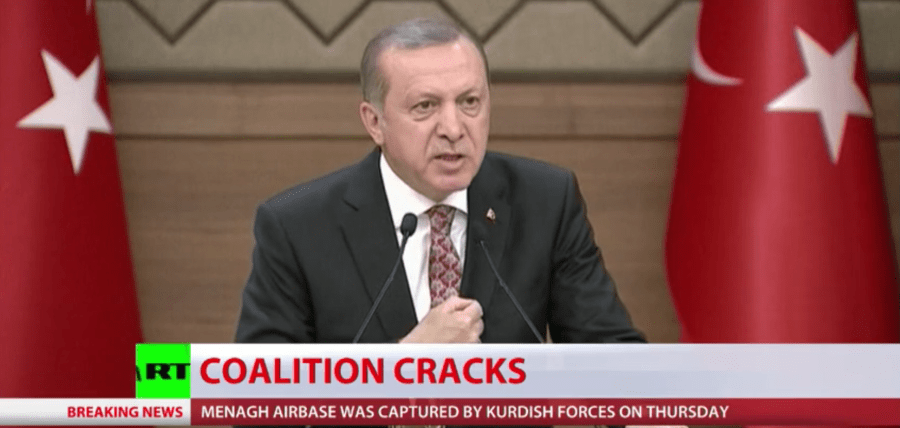
For Turkish President Recep Tayyip Erdogan, the Russian-backed loyalist offensive in Aleppo brings Turkey’s geopolitical imperatives to the fore. The most obvious stressor on Turkey is the potential for tens of thousands of refugees to continue spilling across the border at the same time Europe is curbing the flow of migrants on the Continent. Turkey’s long-proposed solution to this dilemma is not to do Europe any favors by simply absorbing the refugees itself but by creating a “safe zone” in northern Syria where refugees would reside and where Turkey could establish a security perimeter. With a security footprint in northern Iraq, Turkey could then establish a blocking position against the Kurds in northern Syria.
As its relationship with Turkey deteriorated, Russia made no secret of its growing communications with Kurdish rebels in Syria belonging to the People’s Protection Units (YPG). This is an old play in the Russian handbook. As I discussed in an earlier weekly, 1946 was pivotal to understanding the fundamental tension that has persisted between Turkey and Russia for centuries. This was a time when the Soviets, wary of a growing relationship between the United States and Turkey, were also casting a covetous eye on the Turkish-controlled straits, which provided critical access between the Black Sea and the Mediterranean.
The Soviet Embassy in Ankara delivered reports to the Soviet Foreign Ministry on “the Kurdish question,” and Soviet propaganda carefully leaked bits of such reports in the press to ensure that the Turks, as well as the Americans, were aware that Moscow was studying the Kurdish question and was prepared to help ignite Kurdish separatism in the fledgling Turkish republic. One report from December 1946 compiled by the Soviet Foreign Ministry’s Department of the Near and Middle East highlighted that the Czarist government played the Kurdish card regularly to weaken the Ottoman Empire during the late 19th century when it “stirred up discontent with the Turkish government among the Kurds and bought their support with money and lavish promises.”
The lavish promise that Russia can hold in front of the Kurds today is the prospect of a united and autonomous Kurdish state stretching from Rojava in Syrian Kurdistan to northern Iraq. Indeed, the Russian-backed loyalist offensive in Aleppo has enabled the YPG to move beyond its territory in northwestern Syria eastward toward Azaz along the Turkish border. From Turkey’s point of view, the longer Ankara remains behind the Turkish side of the border, the better the chances that Afrin canton has to eventually link up to a swathe of Kurdish-controlled territory west of the Euphrates River, creating a de facto Kurdish state on the Turkish border to go along with the already autonomous and independence-minded Kurdistan Regional Government in northern Iraq. Even if legitimate obstacles render such a scenario unlikely on the battlefield in the near term, Turkey will nonetheless be operating under these assumptions.
And Russia knows not only how to get under Turkey’s skin but also how to make Turkey break out in hives over the Kurdish threat. In a very public move, Russia last week took the liberty of inaugurating an office in Moscow for the Democratic Union Party, the political arm of the YPG in Syria, inviting members from Turkey’s pro-Kurdish opposition People’s Democratic Party and even representatives from Ukraine’s rebel Donbas region for good measure. Bestowing legitimacy on the Kurdish rebel groups that Turkey is painstakingly trying to exclude from the negotiating table while enabling Kurdish rebel advances on the Syrian battlefield was simply too much for Erdogan to bear. As a result, Turkish artillery is now pounding YPG positions in the north around Azaz and Tel Rifaat, and Turkey is repeating the same message back to the White House: Washington and Ankara will just have to agree to disagree on the Kurdish question in Syria.
In our 2016 annual forecast, we highlighted that Russia will intensify its air operations in Syria to try to tie Turkey’s hands but that inaction was not an option for Ankara. Instead, driven by the Kurdish threat among other factors, Turkey would assemble a coalition including Saudi Arabia to mitigate obstacles on the Syrian battlefield. This is exactly the scenario currently in play, with Saudi Arabia and the United Arab Emirates preparing to carry out operations from Turkey’s Incirlik base. Turkey will not allow itself to be tied down by the Russians and will do whatever it takes to force the U.S. hand in enabling a Turkish military move into northern Syria. The Turkish message to Washington is that the Turkish government cannot be regarded as just another tribe or faction on the Syrian battlefield; instead, it is a nation-state with national interests at stake. As Turkish Deputy Prime Minister Yalcin Akdogan said, you cannot play defensively at all times and still expect to win a match.
The United States does not mind Turkey’s being on the offensive in northern Syria if it means stronger action against the Islamic State, but there is still the matter of dealing with Moscow. Turkey, not to mention Saudi Arabia and the United Arab Emirates, is not about to make an impulsive move in northern Syria. All three countries understand the risks associated with putting forces in the air and on the ground with Russian — and potentially even Iranian — fighter jets operating in the same space. The proliferation of players on the battlefield is inevitable, but the task of mitigating the potential for skirmishes falls to Washington.
Bringing the Negotiation Back to Washington
With Aleppo fully in play, all Putin had to do was wait for the phone call. On Feb. 13, the White House told the media that Obama called Putin and urged him to end the Russian campaign in Syria. We can assume that the conversation went well beyond the United States telling Russia to stop it. Russia, after all, designed its intervention in Syria with the hope of it culminating in an understanding with the United States. Syria holds a layer of strategic interest on its own for the Russians, but Syria by itself is eclipsed by a Russian imperative to slow the encroachment of Western military forces in Russia’s former Soviet periphery. While Ukraine remains in political limbo under an increasingly fragile government in Kiev, an increasingly coherent bloc of countries in Eastern Europe is forming around the Visegrad Group (Poland, Hungary, the Czech Republic and Slovakia). Poland, in particular, is pushing for a more robust NATO presence on Europe’s eastern flank with Russia. To improve its chances of coaxing NATO into fortifying its position, Poland is sending a few F-16 fighters to support the mission in Syria as a show of good faith. Discussions meanwhile continue between Washington and Bucharest over boosting NATO’s deployments to the Black Sea, with Turkey more willing to entertain such discussion now that its relationship with Russia has hit the floor.
These are all measures that the United States can escalate or de-escalate depending on how it wants to direct the negotiations it is conducting with Moscow. The United States can assure Moscow that limits will be placed on NATO’s plans for Europe, though any such assurances could well expire with a new president in the White House come January 2017. The United States has also attempted to nudge Kiev on making political concessions toward the eastern rebel regions in Ukraine, but thegovernment is simply too weak and sorely lacking in political will to make the kinds of compromises that would satisfy Moscow.
In Search of Russia’s Achilles’ Heel
Russia has played the Kurdish card effectively against Turkey, but could Moscow eventually get a taste of its own medicine? The volume and spread of Russian protests across the country have increased significantly over the past year as the economic crisis has deepened. Even as the Russian government has pre-emptively cracked down on opposition groups, disgruntled workers and nongovernmental organizations that outsiders could exploit to destabilize Russia from within, it would be impossible to seal all of its cracks.
Legislative elections are slated for September, elections that could test whether a large number of disparate protests can cohere into a more substantial threat on the streets. Even as the Kremlin threatens to place missiles in Kaliningrad, Russian security forces have been cracking down heavily on opposition forces in the exclave territory on the Baltic Sea, where any hint of secession or questioning of Russia’s control over the territory will rapidly capture the attention of the Kremlin.
Russia’s main vulnerabilities tend to be concentrated in the Muslim-majority North Caucasus, where Putin built a legacy on ending the Chechen war. To uphold that legacy, Putin has gone out of his way to endorse the antics of Ramzan Kadyrov, the firebrand leader of Chechnya whose Instagram displays of loyalty to Putin and Trump-like rhetoric have had a polarizing effect on Russian opposition, hardcore nationalists and powerful members of Russia’s Federal Security Bureau. Nonetheless, Kadyrov is a tool to contain Chechnya that Putin will not be willing to sacrifice any time soon. Perhaps more problematic for Putin is a rise in Salafist and ultra-conservative influence in Dagestan, where crackdowns and militant activity are rising and where an overconfident Kadyrov could end up using instability in Dagestan to extend his territorial control.
These pressure points on Russia will be important to watch in the months ahead as Russia navigates the bends and bumps in its negotiation with Washington, Ankara, Berlin and the Gulf states. At the same time, it would be a mistake simply to assume that unrest in Russia will organically swell to the point of overwhelming the Russian government and forcing a reduction in military activities abroad.Russia’s ability to absorb economic pain is higher than most, and the decision to continue operations in places such as Syria and Ukraine rests on far more than financial considerations.
Know Thy Enemy
As the United States calculates its next moves, it must understand the layers to Russian strategy and avoid simplistic characterizations. It is easy to brand Putin a thug and a bully, but Putin understands the limits of brute force and, more important, internalizes the notion of using an enemy’s force against him. This is reflected in his love of judo, which he often describes as a philosophy and way of life. As Putin says, judo teaches that an apparently weak opponent can not only put up a worthy resistance but may even win if the other side relaxes and takes too much for granted. Back in October, the White House and others derided the Russians for not learning their lesson in Afghanistan, expecting the combination of an economic recession and a resource-intensive civil war in Syria to come back to bite the Russians. That day could still come, but the West should not wait for it either.
There is a long stretch in between where Russian strategy will have the potential to penetrate deep into the U.S.-led fight against the Islamic State, the European crisis and Turkey’s existential battle with the Kurds. Putin has already spent a great deal of time, energy and resources into setting up this stage of its negotiation with the United States, but he will also not be deluded by the idea that he can fully attain its geopolitical goals. The realpolitik side of the Kremlin will content itself with partial results, and those results may show themselves on the Syrian battlefield, in eastern Ukraine or — should negotiations fail — not at all. In case of the latter, the next phase of crisis that results will extend well beyond the besieged city of Aleppo.




 Bible Prophecy & Current Events