This article is part of a series authored by STRATFOR – a geopolitical intelligence firm that provides strategic analysis and forecasting. For other articles by STRATFOR click here.
Christmas did not offer much good cheer to the world’s bankers, who have received a sustained kicking since the financial crisis erupted in 2008. In the latest blow, Switzerland announced that it would hold a referendum on a radical proposal that would strip commercial banks of the ability to create money, depriving them of a great deal of their profit-making capabilities. If the Swiss proposal catches on around the world, it could shred core business assumptions that have underpinned the banking model over the past three centuries.
From Babylon to the Central Bank
The earliest banks we know of, in ancient Babylon, were temples that doubled as repositories where one could store wealth. At some point, the guardians of the stored treasure realized they could put this accumulated wealth to work, and banks accordingly began to lend capital. Borrowers would pay interest on what they borrowed, and this interest would ultimately find its way back to the lenders after the banks had taken a cut. The banks became trusted intermediaries that brought lender and borrower together and ensured neither would be cheated. Paper money emerged after people found it was easier to buy things using deposit slips from their bank than carrying gold around.
The next evolution happened when bankers realized that since depositors almost never simultaneously withdrew all their funds, banks could lend more capital than had been deposited. This allowed banks to “create” money in the sense that bankers could issue loans not necessarily backed up by hard deposits. Creating revenue in this way proved lucrative, but it brought banks into conflict with rulers, who were notionally in charge of the state’s money supply and any gains to be made from it. In England, whose financial system is in many ways the progenitor of today’s global system, this battle was played out between banker and ruler in the 16th and 17th centuries.
Ultimately, in 1666 King Charles II — well aware of the limits of his own power thanks to the beheading of his father 17 years earlier — put control of the money supply into private hands. The privatization of the money creation process gave birth to the system we use today, in which private or commercial bank loans are responsible for 97 percent of the money circulating in the modern global economic system. In another change, 28 years after Charles II’s reform, an enterprising group of businessmen offered the government cheaper loans in exchange for certain privileges, such as a monopoly over the printing of physical currency, and so the Bank of England was born.
The benefits of the new system proved immediately apparent. Interest rates on government borrowing dropped from 10-14 percent in the 1690s to 5-6 percent in the early 1700s. This allowed Britain a great deal of leeway when it came to military spending, which it soon put to use. But the privatization of money creation also came with drawbacks, namely the economic cycle of boom and bust. Leaving the money-lending and -creating decisions up to banks resulted in a system of extremes where bankers created speculative bubbles via vast quantities of loans and money when times were good, only to refuse to lend — in a sense destroying money — once an ensuing speculative bubble burst.
This led to liquidity crises, with the South Sea Bubble of 1720 providing early evidence of this mechanism kicking into action. The fact that banks were lending more money than they could back up with capital also left them exposed to bank runs whenever the public lost confidence in them. The reserve ratio, which requires banks to keep a fraction of their loans backed by safer assets such as government debt or central bank money, is an attempt to keep this threat at bay. But it is an inherent characteristic of so-called fractional reserve banking that the risk of bank runs is ultimately inescapable.
Britain, and indeed all the other countries that came to adopt the system, grew accustomed to a regular waxing and waning of the money supply and to the consequent up-and-down economy. There were ways to palliate this cycle, with the Bank of England slowly developing into the stabilizing force it is today. In times of crisis, the Bank of England would lower interest rates and flood the market with liquidity, bailing out any solvent but illiquid banks to keep the system functioning, thus smoothing the money supply’s wilder fluctuations.
As British and then American influence spread, so did banks’ power, and capital flowed ever more freely around the world as domestic deposits were used to finance international projects. The system was heading for a fall, however, when World War I created great economic imbalances between Europe and the United States. In the 1920s, the Federal Reserve attempted to restore prewar parity by keeping interest rates artificially low, but this led to abundant speculative U.S. capital flooding across the Atlantic, particularly into Germany. The ensuing giant bubble finally popped in 1929, leading to the dramatic liquidity shortages of the Great Depression and creating the circumstances that culminated in World War II. The experience led to the partial reining in of banks, with the Glass-Steagall legislation in the United States in the early 1930s limiting their ability to take part in speculative investments.
Time has a way of chipping away at such precautions, however, and the banks gradually escaped their shackles and capital came to flow freely around the world once again. More countries became accustomed to the ebb and flow of bubble and crisis, though these crises tended to be more regional in scope (e.g., Latin America, Asia, Scandinavia). When global crisis finally struck again in 2008 it was different from 1929 in that there was no world war to blame for the global economic imbalances; this crisis followed an extended period of the banks having had things pretty much their own way. Instead, it was a giant version of the regular crises inherent in the system. This led to the thinking that it is the banks, and indeed the system they created around themselves, that need changing. In the eight years since 2008, layer upon layer of 1933-style regulation and restriction have thus been heaped on the banking sector.
A Radical Reform
It is into this atmosphere that the idea of stripping banks of their money-creating abilities has gained currency (regained, in fact, since calls for it date back at least to the 1930s). According to its proponents, the way to root out the instability inherent to the system is to require banks to back their loans 100 percent with reserves. This essentially would be a step back to the point where banks would again function as conduits rather than creators of capital. Under the reformed system the creation of new money would instead be the prerogative of the central bank and the government. These national institutions would in theory be motivated by the needs of the state rather than by short-term profit and would keep the money supply growing at a fixed rate, doing away with the wild fluctuations of the credit cycle. (One challenge to overcome would be politicians attempting to hijack the money supply for short-term political gain.) Proponents of such a system point to many expected benefits: bank runs would be eliminated, the proceeds of money creation would go to the government and thus the taxpayer rather than to the banking elite, government debt would be a thing of the past, and private debt would be greatly reduced. (Indeed, the predominance of debt in today’s world is partly a product of it being required in the money creation process.)
But there also would be great risks involved, the main one being the fear of the evil unknown. Though the economic instabilities of the past 300 years appear to have resulted largely from the fractional reserve system, was it also responsible for the relatively breakneck growth over the same period? Moreover, the changeover from one system to the other would be extremely tricky, requiring vast quantities of central bank money-printing and debt buybacks. That would be a recipe for an extremely fraught period carrying immense risks of mismanagement. In truth, another full-blown financial crisis may have to take place before such a changeover could be made at the global level.
But the theoretical upsides are great, as are frustrations with the current system, and the idea has begun to gather momentum. In 2012, the International Monetary Fund published an influential research paper laying out the case for the proposed system, and in 2015 the Icelandic government commissioned a report on the prospect of undertaking the changes. In Switzerland, a law requiring a referendum to take place should 100,000 signatures be gathered has set the country on a course to possibly being first to undertake the great experiment. Strikingly, the revolution is being considered at both ends of the spectrum: Iceland has lately proved among the most financially adventurous players on the global economic scene, while Switzerland has long been one of the most conservative. Considering the risks involved, adoption in a smaller economy such as Iceland or Switzerland would be a useful test case from a global perspective. It would limit the cost of failure to the global economy while helping establish the best way of adopting the changes should the reforms actually work.
For banks, the prospect is of course nothing less than a nightmare scenario, especially coming on top of all of their existing woes. These have included not only increased regulation but also the threat from a disruptive new technology undercutting their basic model in the form of Bitcoin, the new electronic currency that emerged almost exactly as the financial crisis struck. While Bitcoin has suffered its own wild fluctuations in the eight years since its birth, the technology that underpins it, Blockchain, has truly historic potential. The architects appear to have created an electronic system in which both parties in a transaction can act with confidence without the need for an intermediary, though there is some added risk for the payer, since reversing transactions is more difficult than in traditional banking. The world’s banks therefore face both the prospect of losing their money-creation privileges, as well as a potential usurper threatening their long-established role as the middleman through which all capital must flow. As 2015 fades into 2016, it is hard to think of a time in the past 300 years when the banker’s position in society has been more at risk.
The following is a list of extracts taken from articles this week:
A potential Israeli-Russian ‘nightmare’
“As a result, Russia’s deployment of advanced surface-to-air S-400 missiles is of grave concern to Israel. With a radius of 250 miles and the ability to target up to 36 aircraft simultaneously, the S-400 is a potential game changer. One senior Israeli officer went so far as to describe it as a potential “nightmare.” In the event of a serious deterioration in the Israeli-Russian relationship, the S-400 could greatly complicate the Israeli Air Force’s ability to strike weapons shipments en route to Hezbollah through Syria. Israel therefore needs assurances from Russia that the S-400s will not impinge the freedom of movement Israeli jets possess over Syrian airspace.”
Russia bypasses Israel and sets up a war room with Jordan
“Ever since his major intervention in Syria, Putin has tried to persuade Prime Minister Binyamin Netanyahu to pull the rug from under the Israeli-backed rebels in the South. They are deemed as a necessary buffer for securing Israel’s northern border and blocking the reimposition of Assad’s authority there..
The content of the exchanges between Putin and Netanyahu has only been shared with tight circles of confidants in Jerusalem and the Kremlin, so little is reliably known about their areas of agreement and dispute. By teaming up with Jordan for a joint war room to cover operations in southern Syria, Putin has gone around Netanyahu’s back and acquired a helper for evicting Syrian rebels from southern Syria.”
Russian Forces to stay in Syria Indefinitely:
“In public statements, Russian officials have said the deployment will continue only until regime forces complete “offensive operations” and against Isil and other rebel groups.”
World is facing the worst risks in a generation
“Stock markets are plunging, oil prices are falling further and further, and China is slowing. Experts are increasingly worried about the global economy. Political instability is the worst it has been since the Cold War. Currently, an estimated 60 million people have been forced to flee their homes due to war, poverty and natural disasters. That’s equivalent to the world’s 24th largest country, and the largest number in history.”
The second eldest daughter of Sam and Eliza Johnson was named Frank — not Francine, nor Frances, nor Fran, but Frank. The family story is that, since the eldest child was a daughter, Sam now wanted a son and had already decided on the name. So when Eliza gave birth to another daughter instead, the selected name stayed anyway. Some people say Texans can be very stubborn; they may be right.
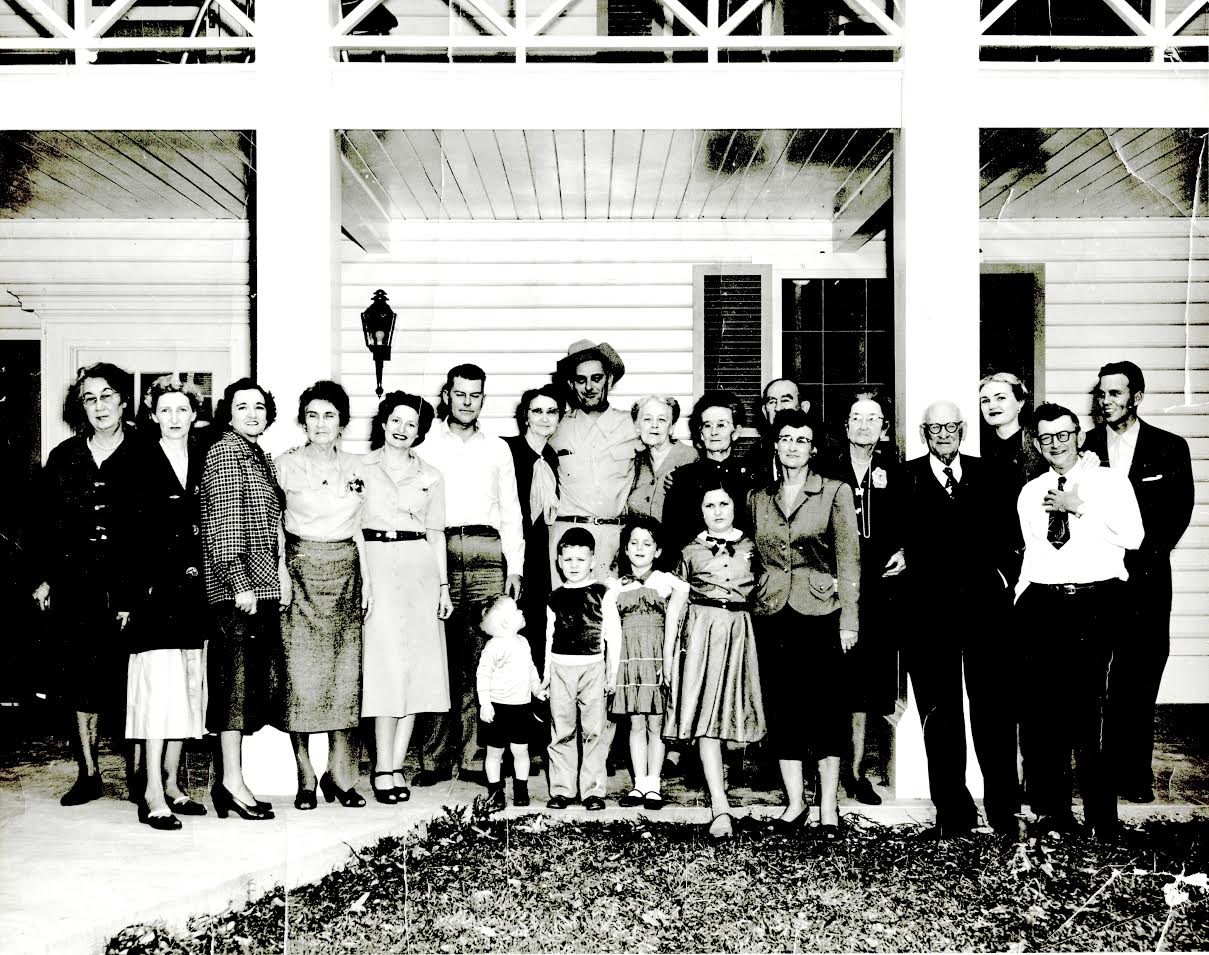
The extended Johnson family at the ranch near Stonewall, Texas, about 1953. My grandmother, his Aunt Jessie, is to the left of Lyndon Johnson, and his mother Rebekah to the right. I am about five years old, standing directly in front of Lyndon. My brother Wesley, age 2, is holding my hand while looking back at Lyndon and our grandmother. Our father Eldon is between my grandmother and Lady Bird Johnson (Lyndon’s wife), and our mother Ruth is second from the left, just to the right of Cousin Oreole. The family picture also contains a number of other Christadelphians. The fourth person from the left of the photo is “Aunt Frank” Martin, who has a chapter devoted to her in my notes.
Frank, born in 1870, become a lifelong Christadelphian, and was very devoted to the Truth. Sister Frank Johnson Martin died in 1961 at the age of 91. As a small child in the 1950s I can remember attending Sunday meetings in her house — a large, rambling old farmhouse. This house was later bought by her nephew Lyndon Johnson and converted into what came to be called the Texas White House during his presidency.
In my childhood memories — probably equal parts fact and fantasy — I always thought of my great-aunt Frank Martin and Eleanor Roosevelt as standing on equal terms. First of all, they were roughly the same age; secondly, they resembled one another more than a little. And finally, they were both, in my mind, larger-than-life women of consequence, who had a lot to say about national and world affairs. And they were both women to whom many important men deferred.
For those of you who don’t recognize the name, Eleanor Roosevelt was the First Lady, that is, the wife of Franklin Roosevelt, who was President of the United States during 13 years in the 1930s and the ’40s, the years of the Great Depression and World War II. During her husband’s presidency, Eleanor was almost certainly his most trusted advisor. Because of the polio which confined him to a wheelchair, she was also his eyes and ears to report firsthand on much that was going on in the country and the world. After his death, she became ambassador to the United Nations, and advisor to other Presidents, and an altogether serious force in American politics for another 17 years or so — probably the first American woman of which that could reasonably be said.
The interesting thing about that is: When I ranked Aunt Frank alongside Mrs. Roosevelt, I may have been more correct than I could have imagined. In national and international affairs, Eleanor Roosevelt loomed very large. But in the very much more limited world of Christadelphian affairs, in parts of the United States and elsewhere, Sister Frank Martin was perhaps just as important.
Frank and her husband owned a large ranch near Stonewall, Texas, just a few miles west of Johnson City in the Texas Hill Country. The ranch house became something of a landmark for Christadelphians both in Texas and elsewhere. It was near the old Christadelphian campground, and a place where many brothers and sisters would gather from time to time for Bible study, fellowship, and worship. On such occasions and in private also, Sister Frank offered sound scriptural advice to brothers who asked, and her words were highly valued. In between, she is known to have gently and diplomatically played matchmaker when the situation called for it, and with some success, as some folks living today can attest.
Frank’s husband, Clarence Martin, was in politics, like Sam Johnson, Jr., his brother-in-law. He was a state legislator and then state district judge in the Texas Hill Country. But Frank had always encouraged him, subtly sometimes, to read the Bible and understand it. When he went to Austin for legislative sessions, or for court duty elsewhere, she always packed something to read in his luggage — perhaps Elpis Israel or Seasons of Comfort or similar reading, to go with his Bible. Mostly, he never gave any indication that he was reading, but eventually, when he retired, he was finally baptized as a Christadelphian and remained faithful to the Truth until his death.
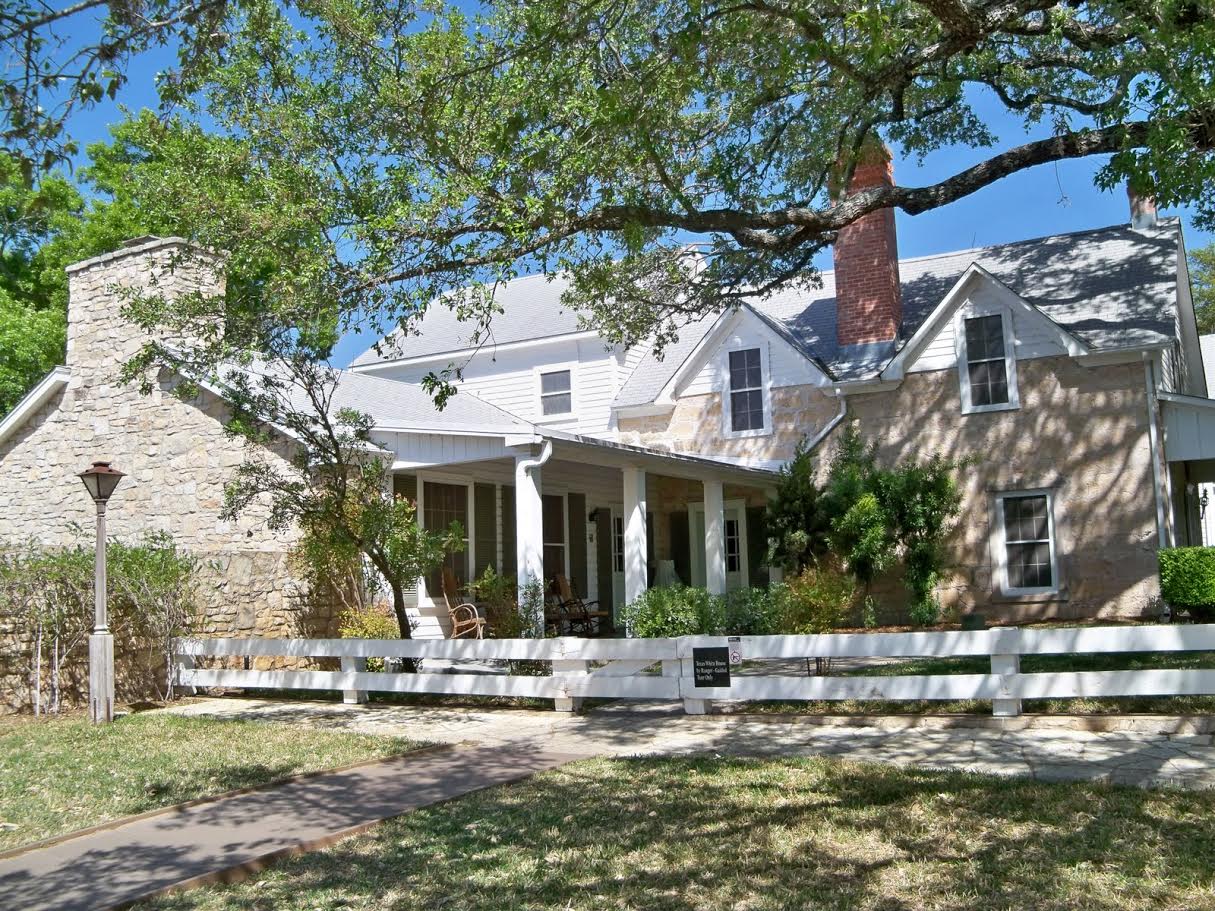
This is the Johnson Ranchhouse, also called the Texas White House during the Presidency of Lyndon Johnson (1963-1969). It was originally owned by Clarence Martin and his wife Frank Martin, as mentioned in my story, and was bought by Lyndon and Lady Bird Johnson from his Aunt Frank during her later years. It is now owned and administered by the state of Texas and the United States park services.
Both before and after her husband Clarence’s death, Aunt Frank was an eminence in the Christadelphian brotherhood in North America. One prominent brother from Canada, visiting Texas in 1952 to attend the Texas fraternal gathering, a weeklong activity similar to today’s Bible schools, wrote in a circular newsletter of meeting Sister Frank Martin, whom he called “a mother in Israel”. He added: Sister Martin has been a succourer of many, and like Paul I can say, “and of me also”… she has spent a good portion of her life in the truth, and what a colorful pilgrimage it has been… Sister Martin has taught the truth to many and is still watchful over God’s children and keeps the brood under her protecting wings… she is loved and respected by all who know her, in the truth and those not in the truth. She lets her light shine before men, as her nephew, Lyndon Johnson the [United States] Senator, said of her when someone remarked of her not being at home: “Aunt Frank will not be found home until the Christadelphian gathering is over.” Truly a wonderful testimony from one not in the truth to one that is in the truth, and it was not spoken in sarcasm, but with a soundness which he knew and also fully respected; for as men and women can see that our sister has been with Jesus.
One incident about Aunt Frank stands out in my memory, as told years ago by one of my older cousins. It was about 1922 when two circumstances converged, more or less. First, Aunt Frank’s husband, not yet a Christadelphian, was district court judge for the Hill Country region. And second, the brothers and sisters meeting regularly at the old campground, just down the road from their ranch near Stonewall, felt they needed more than just the old building and the outdoor covered “tabernacle”; they needed a proper meeting hall on the Christadelphian land. The problem was they lacked funds even to buy building materials. As she listened to the brothers trying to figure out how to raise the necessary funds, Sister Martin volunteered that she would take care of the money if the brothers could manage the building project itself, and they readily agreed.
My cousin could tell this story because she accompanied her aunt on her tours around the Hill Country. Aunt Frank decided that it was only right that, as the wife of the judge in the region, she should pay calls to as many constituents in the area as possible, to introduce herself and get to know them better. Taking her young niece along and driving herself, she set out, day after day, to make her rounds. In addition to letting folks know who she was, and especially who her husband was, she talked with them about anything and everything else in their lives.
Then, before she departed from each place, she mentioned that, by the way, she was also collecting funds to help build a Christadelphian church at the old campgrounds. Not surprisingly, perhaps, practically everyone was happy to donate to this worthy cause. When she had finally collected all that was needed, she delivered the funds to the brothers and informed them that her work was finished, but theirs was just beginning. I can add that the church structure still stands today, more or less as it was when first finished almost 100 years ago.
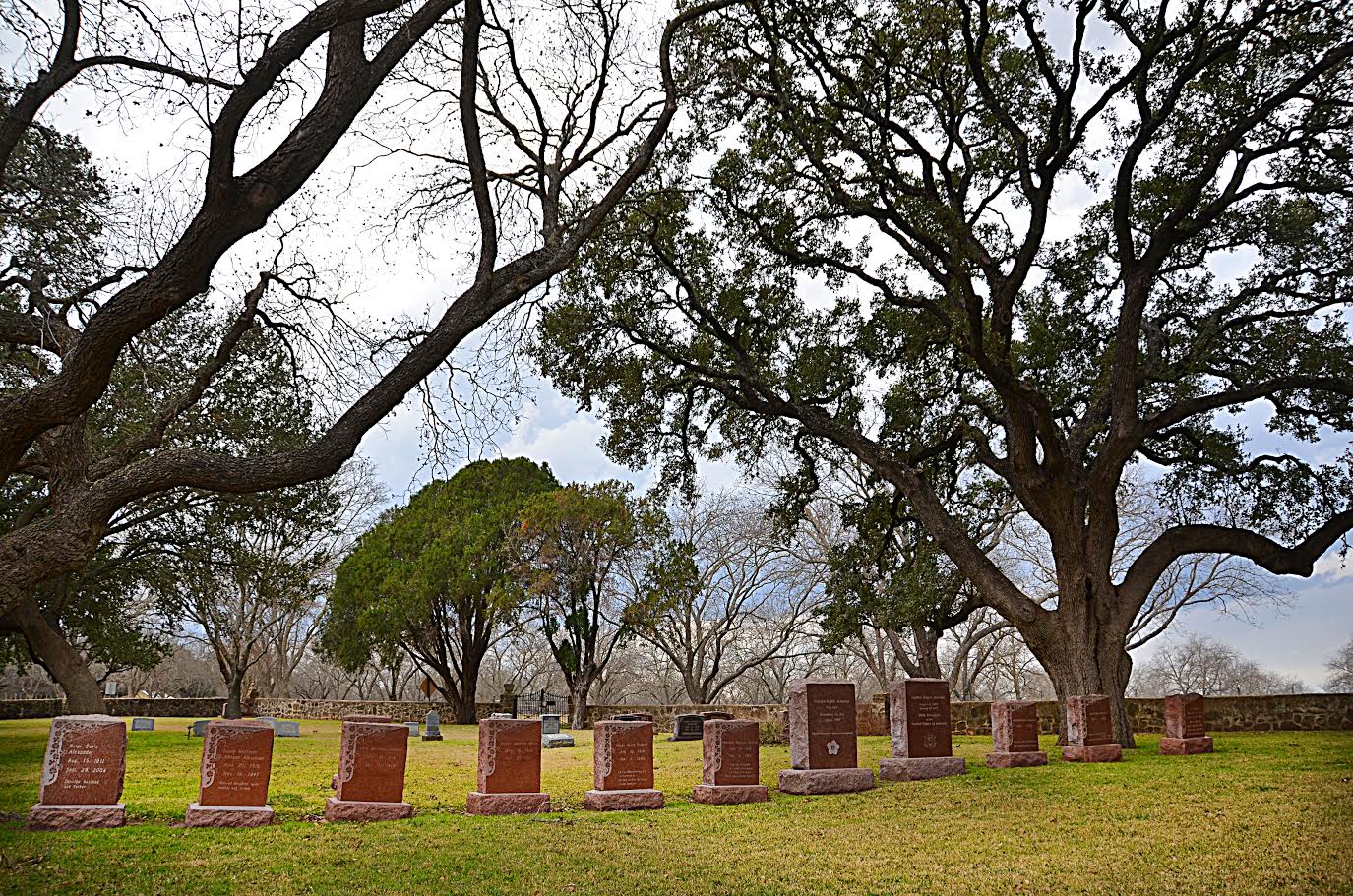
More than half of the 50 or so folks buried here are Christadelphians. They include: my great-great grandmother, Priscilla Bunton, the first Christadelphian in the family; my great grandparents, Sam Ealy Johnson and Eliza Bunton Johnson; my grandmother, Jessie Johnson Hatcher; my parents, Eldon Booker and Ruth Hatcher Booker; my brother and only sibling, Wesley Booker; as well as a number of great-aunts, some cousins, and a few close friends of the family (who were not related by blood but simply by faith). The cemetery is administered by the United States National Parks Service.
In her later years, and when overseeing the ranch itself became too much for her, she sold her house and lands to her nephew Lyndon Johnson, then a United States Senator. Frank herself, with another Christadelphian lady Margaret Martin as a companion, took up residence in a small house in nearby Johnson City, the house which had been a Johnson family residence and Lyndon’s boyhood home. This much smaller residence also became a destination for many folks to visit during her last years — Christadelphians from around Texas and the country. My brother Wesley and I slept a number of nights on the screened-in porch of that house during the summers, while our mother and grandmother were visiting Aunt Frank.
Sister Frank Martin died in 1962, at the age of 91, and is buried in the Johnson Family Cemetery alongside so many relatives and other Christadelphians.
Meanwhile, the old ranch house, refurbished and expanded, became the famous Texas White House during Lyndon Johnson’s presidency from 1963 to 1969, and a place where various important politicians and heads of state visited. It is still part of the Lyndon Johnson National Historical Park.
To be continued.
This post is part of a series authored by brother George Booker. Click here to see all previous posts in the series.
This article is part of a series authored by STRATFOR – a geopolitical intelligence firm that provides strategic analysis and forecasting. For other articles by STRATFOR click here.
A powerful explosion went off in Istanbul near the city’s most prominent tourist attractions on Jan. 12, killing at least 10 people and injuring six foreign tourists. The blast, which took place in front of the ancient Egyptian Obelisk of Theodosius and near the Blue Mosque in the Sultanahmet district, reportedly involved a suicide bomber. Though the Turkish government is currently in conflict with numerous terrorist and non-state militant groups, the location, target and method of attack point to the Islamic State as the primary suspect behind the operation. In comments made after an hour long meeting of the country’s National Security Council, Turkish President Recep Tayyip Erdogan said the suicide bomber was of Syrian origin.
By cracking down on the Islamic State and actively supporting rebel operations against the extremist group in Syria, Turkey has knowingly made itself a target of the many groups loyal to the Islamic State. Furious at the disruption of their vital supply lines through Turkey because of the crackdown, which has steadily intensified since July 2015, Islamic State leaders have repeatedly vowed to launch severe retaliatory attacks. The first serious attack occurred last year on July 20, when the group staged a suicide bombing attack in the Turkish town of Suruc, near the Syrian border. Turkish raids and arrests stopped several other planned attacks, but not all of them; on Oct. 10, the group struck again in Ankara.
The latest attack, which hit in the heart of Istanbul’s oldest quarter, could galvanize an even stronger Turkish response against the Islamic State. Indeed, Ankara has already been pushing its allies to support it in an operation in Syria’s northern Aleppo province that aims to create a buffer zone in the Azaz-Jarablus zone. A successful operation would serve Turkish interests by hurting the Islamic State, strengthening the rebel position in northern Syria, preventing the Kurdish People’s Protection Units (YPG) from expanding farther westward and — because Turkey does not want to go it alone — drawing the United States deeper into the conflict.
However, Russia’s intervention in Syria has greatly complicated Turkey’s plans for the operation, and in the wake of Turkey shooting down a Russian Su-24 warplane, Moscow continues to frustrate Turkish ambitions in the country. The Russians, for instance, have reinforced their air defense assets in Syria, and in a Dec. 17 interview, Russian President Vladimir Putin dared Turkey to fly over Syrian airspace with the implication that the aircraft would be shot down if it did. Faced with the prospect of a potential war with Russia if it proceeded with an armed incursion into Syria, Ankara has been forced to revise its plans for northern Aleppo.
In spite of the risk that Russia poses, Turkey could increase its involvement in Syria. This latest Islamic State attack on a Turkish city comes at a time when the Kurdish-dominated Syrian Democratic Forces have crossed the Euphrates River in their push westward and Russian- and Iranian-backed loyalist offensives have ratcheted up the pressure on Turkey’s Syrian rebel proxies. The Turks may choose to carry out intensified strikes with long-range missiles from the safety of their own borders, but a greater Turkish incursion into Syria cannot be ruled out.


 Bible Prophecy & Current Events